Open-Source MCP Gateway for Enterprise IT

A secure, enterprise-grade MCP gateway and control plane that centralizes your MCP servers, access policies, auditing, and integrations for AI agents.

What is an MCP gateway?

The MCP Gateway is the central point of control for all Model Context Protocol (MCP) servers inside an organization. Obot provides a unified gateway that manages:

  • MCP server onboarding
  • Access control & identity integration
  • Security policies and audit logs
  • AI agent connections
  • Cataloging and discovery of MCP capabilitie
Schedule A Demo

Secure MCP Management Unlocks Enterprise AI

MCP servers enable AI tools and agents to connect with internal systems — but discovery, documentation, security, and governance are often fragmented and chaotic.

  • Onboard and manage MCP servers
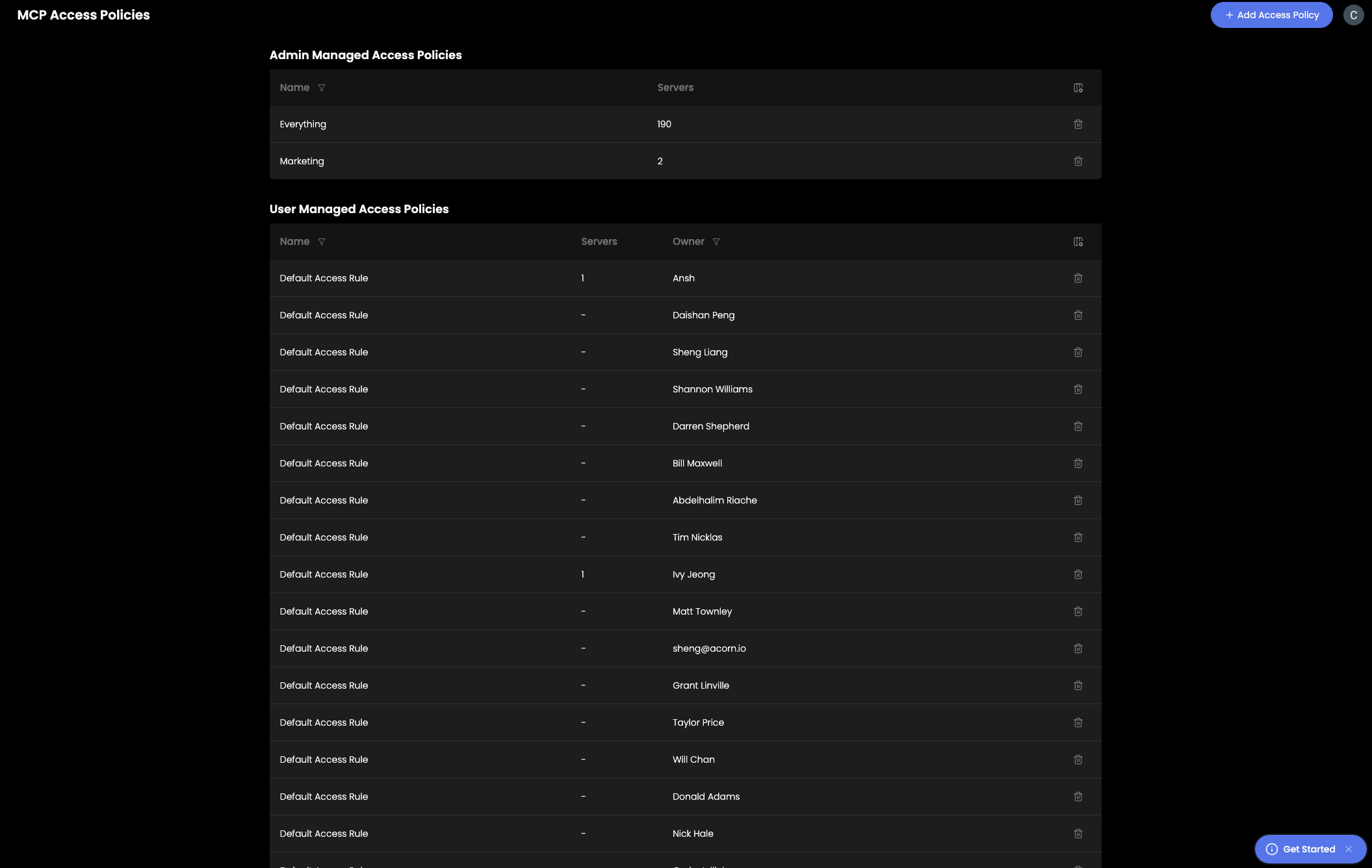
  • Define secure access policies
  • Track usage, performance, and compliance
  • Help users find and connect to trusted MCPs

Obot: A complete platform for MCP

Central Control Plane for IT

Define access control policies, onboard new MCPs, track usage, and troubleshoot—all from a modern UI or GitOps flow.

Universal MCP Hosting & Proxying

Support local, remote, and multi-tenant MCPs. Host your own when needed, and route everything securely through Obot.

Automated Documentation & Discovery

Give users a searchable directory of available MCPs—complete with live documentation, capabilities, and IT-verified trust levels.

Instant MCP Connections

Users generate URLs to connect MCPs to their favorite AI clients, or interact with them directly via Obot’s chat client.

MCP Catalog & Discovery

Obot includes a built-in MCP Catalog that provides structure, discovery, and documentation across all MCP servers. Your teams get MCP discovery, architecture insights, schema visibility, and connection details in a single interface.

MCP Server Management & Integration

Manage all your MCP servers — including PostgreSQL-backed and custom internal servers — through one secure gateway. Obot makes MCP integration simple with built-in hosting, routing, and identity enforcement.

AI Agents & MCP

Obot gives AI agents — such as Claude, Cursor, VSCode, or internal agents — secure access to your internal systems via the MCP Gateway. Policies ensure agents access only what they’re permissioned for.

MCP Monitoring & Audit Logging

Obot provides enterprise-grade logging and monitoring so IT and security teams can track usage, detect anomalies, and enforce governance policies across all MCP servers and AI agents in your organization.

Obot MCP Gateway gives IT a complete control plane for securely managing MCP servers, while providing users a seamless way to discover and connect to them.

01

Admin Setup & Integration

IT teams deploy the Obot Gateway Server and connect it to their organization’s identity provider—such as GitHub, Google, Okta, or Microsoft Entra. This establishes secure, authenticated access for all users.

02

Catalog Configuration

Out of the box, Obot includes a library of popular MCP servers (e.g., Outlook, Slack, Notion, GitHub). IT can add additional internal or third-party MCPs via the UI or through GitOps workflows.

03

Access Control & Policy Management

Admins define which users and teams can access which MCPs, using fine-grained access policies. These policies ensure only authorized employees can discover and connect to approved services.

04

User Discovery & Connection

Once published, users log in to browse their personalized MCP catalog. Each listing includes descriptions, capabilities, and usage guidance. When a user selects an MCP, Obot generates a unique connection URL that can be used with AI clients (e.g., Claude, Cursor, VSCode, enterprise chat tools, or custom agents).

05

Intelligent Routing & Hosting

If it’s a remote third-party MCP (e.g., from Zapier or AWS) Obot proxies all traffic, enforcing policies and logging access. If it’s a hosted MCP, Obot automatically deploys the server in a container on the organization’s Kubernetes cluster, running it securely on-demand.

06

Full Visibility & Control

All interactions are routed through Obot’s secure proxy layer, allowing IT to monitor usage, audit access, troubleshoot issues, and manage updates from a centralized control plane.

MCPs are becoming the backbone of AI integration. Without a control layer, organizations risk shadow infrastructure, data leaks, and lost productivity. Obot helps you accelerate adoption and stay in control—before the chaos spreads.

Schedule a Demo

Get started

Ready to scale your MCP
infrastructure without losing
control?

FAQ

Product FAQs

Obot supports both local and remote MCP servers. For local MCP servers, they are hosted on the Obot platform and published as a remote MCP server to clients.

Obot supports any MCP hosts and clients that can connect to remote MCP servers. Obot does include an out-of-the box Chat interface but will support all of the popular MCP hosts such as Cursor, Claude Desktop, VSCode, and Cline.

Obot is built for all of these teams. IT admins use Obot to onboard, secure and manage MCP Servers. Developers access authorized MCP servers via the Obot Catalog. Business users can interact with MCP servers safely by accessing a curated list of MCP servers via the catalog and connecting them to their preferred MCP chat client, or access them via the Obot Chat interface.

Obot supports identity providers like Google and GitHub. Obot Enterprise edition includes support for Okta and Microsoft Entra.

Obot enforces strict authentication and authorization for every request, with full audit logs and policy controls. You define what MCP each user can access and Obot ensures only those requests are allowed through.

Yes Obot is open-source and free to use. You can download the open source edition here. You can self-host it or run it in your own cloud environment. If you need support, or features like Okta or Entra support, we offer Obot Enterprise Edition.

You can launch a pilot in minutes by deploying Obot on any Kubernetes cluster. Out of the box, Obot includes a curated set of common MCP servers that we maintain. Once you have Obot running, you can add in your internal MCP servers, configure access control and security policies, and then publish your MCP catalog to internal employees.

Latest News

Obot AI Donates the MCP Dev Summit to the Linux Foundation — and a New Chapter Begins for Agentic AI

Obot AI is donating the MCP Dev Summit to the Linux Foundation under the new Agentic AI Foundation (AAIF). After 2025 events in San Francisco and London, the summit will transition starting with the April 2–3, 2026 New York event. CFP is open.

Read More

Introducing MCP Registry Support in Obot v0.14

Visit our GitHub page to download the current version of Obot & get started. We’re excited to announce the release of Obot v0.14, which brings MCP Registry Support to the platform. This release empowers organizations to control exactly which MCP servers their users can see and install—across VS Code, GitHub Copilot, and any MCP-registry enabled […]

Read More

The MCP Maturity Model: Full Framework Now Available

We’re releasing the full MCP Maturity Model—a practical framework with stage definitions, readiness checklists, and implementation guidance to help enterprises move from shadow adoption to scaled deployment. Includes real-world patterns we’re seeing and how Obot supports each stage.

Read More

Automate Your WordPress Publishing: A Simple Obot MCP Setup Guide

If you have a WordPress site or two, you probably know that it can be tedious to log, start writing an article, review it, setting it to be published at a certain time, etc. Let’s try using WordPress through an MCP, with Obot, to automate things for us. Let’s see what we actually can do, […]

Read More

Announcing Obot MCP Gateway v0.13.0: Composite Servers, Fine-Grained Tool Access, and More

We’re excited to announce the release of Obot MCP Gateway v0.13.0. This update introduces composite MCP servers, fine-grained tool access control, expanded audit capabilities, new admin tools, and a range of improvements across the UI, backend, and deployment experience. Composite MCP Servers and Fine-Grained Tool Access Control Admins and owners can now create composite MCP […]

Read More

What Is an MCP Gateway? Why Enterprises Are Adopting a Control Plane for MCP

MCP made it easy to connect AI to tools. Scale made it messy. Here’s a plain-English answer to “What is an MCP Gateway?”—and how it turns ad hoc MCP sprawl into an enterprise platform.

Read More

Obot at AI Native DevCon New York

Join the Obot AI team at DevCon in NYC Nov 18-19, 2025 – stop by to learn more about how MCP is changing the AI development landscape.

Read More

Announcing Obot MCP Gateway v0.12.0: Auditor Role, Bulk Admin Actions, Okta Group Support, and More

We’re excited to announce the v0.12.0 release of the Obot MCP Gateway! This update brings major improvements for enterprise security, admin operations, and user flexibility. Here’s a preview of all the new features: So what’s new? New Auditor & Owner Roles for Granular Access Control We’ve overhauled our role-based access control (RBAC) system with two […]

Read More

The Practical MCP Tools Landscape — Who’s Building What, and How to Pick the Pieces

If you want to understand the Model Context Protocol (MCP) ecosystem today, don’t start with buzzwords — start with the tools. MCP isn’t a single product: it’s a set of conventions that a growing number of projects and companies use to let LLMs call out to real systems. That means the ecosystem is naturally fragmented […]

Read More

Announcing Obot MCP Gateway v0.11: Project Sharing, Power User Roles, and More

Discover Obot MCP Gateway v0.11 — now with project sharing, power user roles, enhanced permissions, and governance upgrades for scalable enterprise MCP deployment.

Read More

Obot AI Secures $35M Seed to Build Enterprise MCP Gateway

Obot raises $35M seed funding to accelerate development of its enterprise-grade MCP Gateway—enhancing governance, security, and scalability for MCP deployments.

Read More

Acorn Labs is Now Obot AI

Big news: Acorn Labs has a new name, a new look, and a bigger vision – We’re officially Obot AI. This change isn’t just about a logo swap—it’s about reflecting who we’ve become and where we’re headed. Since the launch of the Obot MCP Gateway we are focused on building powerful, real-world AI solutions with […]

Read More

MCP Hosting: Building a Strategy for Deploying and Running MCP Servers in the Enterprise

Discover how to build a secure, scalable MCP hosting strategy—manage single-tenant, shared, and third-party MCP servers with centralized governance and control.

Read More

Connecting Microsoft Office 365 MCP Servers in Obot

Connect Microsoft Office 365 via MCP in Obot to enable secure access to email, calendar, files & more—manage permissions, auditing, and governance centrally.

Read More

Introducing Nanobot: A New Framework for Turning MCP Servers into AI Agents

Turn your MCP servers into fully interactive AI agents with Nanobot — get reasoning, tool orchestration, UI components, and rich agent behavior in one open-source framework.

Read More

Hands-on workshop [London | Oct 1] Building Next Generation Agents with MCP and Next Generation Agentic UX powered by MCP UI

Join the Obot AI & MCP-UI teams for a two-part hands-on session where we will build next generation AI agents that work as MCP servers and can provide rich, graphical interfaces using MCP UI.

Read More

Update on the MCP Registry Project, new ChatGPT support for MCP and what it means for Enterprise AI

Learn about the launch of the MCP Registry, ChatGPT’s new MCP support, and how enterprises can use Obot’s MCP Gateway for secure discovery, governance & control.

Read More

MCP Developers Summit [2 Oct | London]

On 2 Oct 2025 the Obot team will be in London at the MCP Dev Summit – register now to connect with us at the event!

Read More

Deep dive into the Obot MCP Gateway

Get an in-depth look at the Obot MCP Gateway: architecture, access control, security features, cataloging, and observability for enterprise MCP adoption.

Read More

Online Workshop [Sept 25 @ 9am PT] Bringing Model Context Protocol to the Enterprise: From Chaos to Catalog

Free hands-on workshop (Sep 25, 2025): Learn how to build a secure, scalable MCP catalog using best practices, architecture guidance, and a live Obot demo.

Read More

Why Every Organization Needs an Enterprise MCP Strategy

Explore why enterprise-level MCP strategies are becoming mission-critical—empowering CIOs with scalable, secure AI tools and setting the stage for widespread MCP adoption.

Read More

Building an MCP Registry: Why It Matters and How to Get It Right

Discover how to build an enterprise-grade MCP registry – centralize discovery, ensure governance, automate onboarding, and maintain secure AI infrastructure at scale.

Read More

Managing Access Control for MCP Servers in the Enterprise

Learn how to implement enterprise-grade access control for MCP servers—integrate with identity providers, scale securely, simplify IT management, and ensure compliance.

Read More

What Is Secure MCP Access? Why It Matters for Enterprise AI

Understanding secure MCP access and how to achieve it is critical for anyone adopting MCP across their organization.

Read More

The Value of an MCP Proxy: Security, Control, and Observability for Enterprise AI

Learn why an MCP Proxy is essential for enterprise AI—enabling centralized security, access control, and observability for trusted MCP workflows.

Read More

Online Workshop – Bringing Model Context Protocol to the Enterprise: From Chaos to Catalog

Free hands-on workshop (Sep 10, 2025): Learn how to build a secure, scalable MCP catalog using best practices, architecture guidance, and a live Obot demo.

Read More

Security risks in the Model Context Protocol: What you need to know

Discover the top security threats in the Model Context Protocol (MCP)—from prompt injection to tool poisoning—and learn how to safeguard enterprise AI integrations.

Read More

From Slack Pings to Answers: Five Lessons from Shipping an Enterprise MCP Server

Learn how MCP Slack Automation transformed Jira, Confluence, and New Relic queries into instant Slack answers with security, reliability, and trust.

Read More

Evaluating Enterprise MCP Gateways

Explore how to evaluate enterprise MCP gateways — comparing Obot, Microsoft, IBM on security, catalog, deployment, integration, observability, and extensibility.

Read More

Creating Your First MCP Server: A Step by Step Guide

Learn to build your first Model Context Protocol (MCP) server in Python—create tools, connect to Claude, fetch real-time data, and extend its functionality.

Read More

Online Workshop: Bringing Model Context Protocol to the Enterprise: From Chaos to Catalog

Online Workshop: Bringing Model Context Protocol (MCP) to the Enterprise. Tune in Wed. Aug 20 @ 10am PT

Read More

Introducing the Obot MCP Gateway

Obot MCP Gateway is a free, open-source platform to securely manage, catalog, and scale MCP server adoption in the enterprise—featuring role-based access, audit logging, and Kubernetes deployment.

Read More

Understanding the Model Context Protocol: A  Beginner’s Guide

Learn how the Model Context Protocol (MCP) standardizes AI-to-tool communication—enabling secure, reliable, and scalable integrations across services.

Read More

What are MCPs? A Simple Introduction

MCP or Model Context Protocol is a relatively new concept in the world of AI, but what is it and how can it help you?

Read More

Top 15 MCP Servers

There are more and more MCP servers coming out every day, and the list is becoming long. There are a lot of good MCP servers, and a lot of MCP servers that might be useless to you.

Read More

Beginner’s Guide to AI Agents with Obot

Beginner’s guide to AI agents and an Obot demo (Gmail + Docs). See how Obot MCP Gateway adds governance, access control, and auditability for teams.

Read More

Building a Kubernetes Home Lab from the Ground Up

Introduction This is the first in an ongoing series of posts on building and running a Kubernetes Home Lab. I recently came across the concept of Home Lab, where you set up some servers at home to do miscellaneous stuff such as hosting home utilities or running various applications locally. Some examples of home utilities […]

Read More

Selecting Between Docker Desktop, Rancher Desktop and Podman Desktop

We evaluated three leading local container management solutions to uncover their strengths and weaknesses. Building microservices applications requires developers to work closely with containers not just in the cloud, but locally on their development machine. In this article we will focus on finding the best tools when it comes to building and running a containerized […]

Read More

Introducing GPTScript …Officially

Last month I introduced GPTScript with a tweet and it’s been exciting to see how it’s captured people’s imagination. But other than that tweet and the readme on our GitHub repo, I never wrote a proper blog introducing GPTScript, which feels like an oversight. I am incredibly excited about the potential of GPTScript, and at […]

Read More

A Complete Guide to Open Source Software

What Is Open Source Software? Open source software (OSS) is a type of software whose source code is available to the public. This means that anyone can view, modify, and distribute the software as they see fit. OSS is an alternative to the traditional proprietary software model, where the source code is kept secret and […]

Read More

Comparing Nextcloud and ownCloud for Self-Hosted Cloud Storage

A few decades ago, data was in physical form. Whether it was personal photographs or a company’s financial records, all of them were on paper. However, with the changing technological landscape, everything moved from paper to silicon. From our vacation pictures to official financial records, everything went digital and was stored on computers. And that’s […]

Read More

Read More