AI agent frameworks are software libraries or platforms that support the development, deployment, and management of intelligent AI agents. AI agent frameworks provide foundational building blocks for autonomous applications, offering reusable agent abstractions for the parts of an agent that would otherwise get rebuilt from scratch on every project: reasoning over a goal, calling tools, tracking state across multiple steps, and recovering when something in the chain fails. AI agent frameworks enable models to reason, plan, and execute complex workflows by giving developers standardized abstractions instead of custom glue code for every integration. AI agent frameworks are ideal for applications requiring long-running workflows and tool integrations, which is a different problem than a single prompt-response call to a model, and it’s the problem this category of software exists to solve.
Why Use an AI Agent Framework for Building AI Agents
Using frameworks enables faster prototyping and time-to-market for AI systems, and the reasons compound rather than stand alone. AI agent frameworks help reduce boilerplate code for developers. Authentication, retry logic, and tool-calling scaffolding are solved problems in a mature framework, not something a team writes fresh for each agent. Framework architectures are modular and allow easy swapping of LLMs and tools, which matters specifically because the underlying model landscape changes every few months and an agent locked to one provider’s SDK becomes a rewrite project the day that provider falls behind. Autonomous systems can utilize AI agent frameworks to break down tasks into subtasks, coordinating specialized agents that each handle one part of a larger goal rather than asking a single model to hold the entire task in context at once.
Key Components of an Agent Framework
An agent framework typically includes four functional pieces.
Agent. The core entity responsible for interacting with its environment: perceiving input, deciding what to do, taking action, and learning from the outcome.
Environment. Everything external to the agent that it interacts with, from a database to a live API to another agent. Frameworks generally provide simulated environments for testing an agent before it touches production systems.
Perception. How the agent gathers information, whether from a data feed, a tool response, or direct human input. Tool integration allows models to interface with external systems like APIs and databases, and perception quality determines how reliably the agent understands what it’s actually looking at.
Action. The agent’s ability to affect its environment. Built-in connectors allow LLMs to safely invoke external functions, executing a task, writing a record, or calling another agent, based on what perception and decision-making produced.
How Agent Workflows Actually Execute: The Agent Loop
AI agent frameworks structure execution using a continuous feedback loop: perceive, decide, act, observe the result, repeat. That loop is the mechanical core of every framework on this list, and the differences between frameworks mostly come down to how much control a developer has over each step of it.
Orchestration controls how agents decide what to do next. Some frameworks handle this with an implicit agent loop where the model decides the next tool call on its own. Others use explicit graph control, where a developer defines nodes and edges and the framework routes execution deterministically between them, which trades some autonomy for predictability in production concerns like debugging and rollback.
Tool calling is how an agent reaches outside its own context window. Tool execution needs to be scoped, since a tool calling agent with unrestricted access to every available function is a different risk profile than one scoped to exactly what a task requires.
State management tracks the progress of multi-step workflows. Memory management tracks short-term context and long-term persistent state separately, since what an agent needs to remember for the next three tool calls is a different problem than what it needs to remember across sessions spanning days. Context management and vector databases typically handle the second case, retrieving relevant history rather than holding the entire conversation in the active context window. Session-based state management lets an agent pause mid-task and resume later without losing where it was, which matters for multi-step tasks that don’t complete in a single execution window.
Durable execution extends that further: if the process running an agent crashes mid-task, a durably executed workflow resumes from its last checkpoint instead of restarting from zero. For multi-agent execution paths where several agents depend on each other’s output, that durability is the difference between a recoverable failure and a task that has to run again from the beginning.
Multi-agent coordination allows agents to collaborate and solve complex tasks, with inter-agent communication handled either through a shared orchestrator or through agents calling each other directly as tools. Multi-agent patterns range from a simple pipeline where one agent’s output feeds the next, to multi-agent orchestration where a coordinator dynamically assigns subtasks based on which specialized agent is best suited for each piece of the goal.
Why Model Context Protocol and A2A Support Now Decide Agent Development Choices
A framework choice made in 2024 didn’t have to account for how an agent connects to external tools in a standardized way. A framework choice made now does. Model Context Protocol has become the default way agents discover and call tools without custom integration code for every server. Most frameworks compared here now support it natively rather than through a third-party adapter, and that support is no longer a nice-to-have. An agent built on a framework with native MCP support can connect to any compliant MCP server, internal or external, without the framework maintainer having to ship a bespoke connector for it. The flip side is that an agent able to connect to any compliant MCP server needs something deciding which of those servers it should actually reach. That’s the job of a control layer like Obot’s MCP gateway, not the framework itself. A2A (Agent2Agent) is the newer, less settled protocol in this space, aimed specifically at letting agents built on different frameworks discover and invoke each other. Support is uneven: some frameworks ship it in core, others through a separate adapter package still in beta. Treat A2A maturity as a genuine differentiator when evaluating frameworks for a multi-framework environment, and treat any framework’s A2A claims as worth verifying directly against current release notes before you commit to it, since this is one of the fastest-moving parts of the ecosystem right now.
Notable AI Agent Frameworks in 2026
The field has changed enough since the last major refresh of this comparison that some entries from earlier lists no longer make sense as standalone recommendations.
1. LangChain
LangChain remains the most broadly adopted framework for chain-based and agentic LLM applications, reporting roughly 134,000 GitHub stars and over 1,000 pre-built integrations at the time of writing. Star counts and integration counts move quickly in this ecosystem; verify current figures against the LangChain GitHub repository before citing them in a procurement document.
Custom agent workflows: Supports custom agent and multi-agent workflows via LangGraph, offering human-in-the-loop control and native streaming for reliable execution.
Plan-and-execute architecture: Includes several prompting strategies like plan-and-execute, critique revise, and self-ask to ensure agents perform optimally.
Tool integration: Offers a library of pre-built tools and the ability to customize tools for specific tasks, improving agent functionality.
LangSmith debugging: Provides explainability and debugging tools, including end-to-end trace observability, tool selection visibility, and performance tracking for agents.
Collaborative agents: Supports workflows where multiple agents collaborate on a common goal, enhancing task execution efficiency.
Best for: Teams that want the broadest tool and integration ecosystem and are comfortable with Python-first development.
2. LangGraph
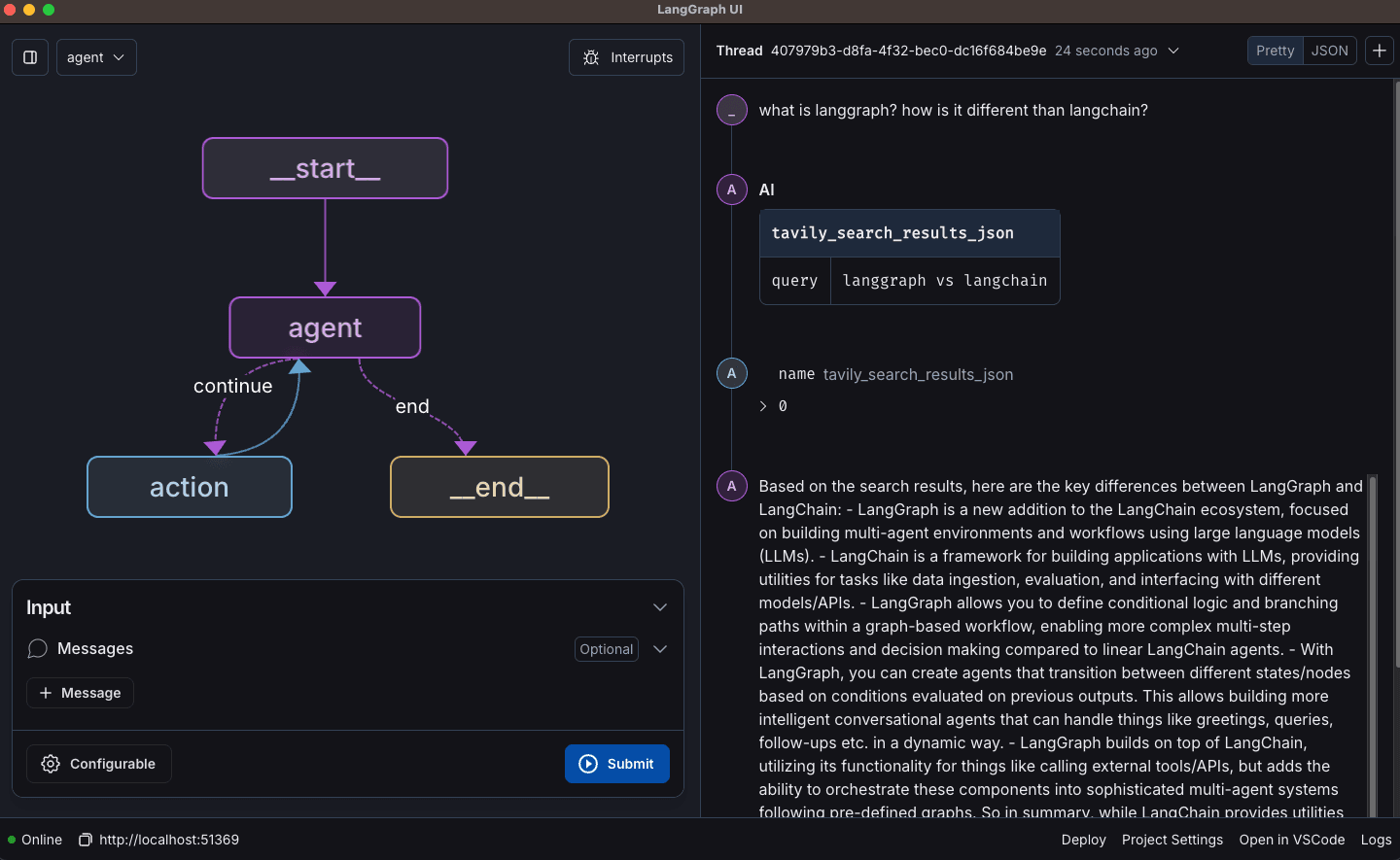
LangGraph, built by the LangChain team, models agent workflows as directed graphs rather than a linear chain, giving developers explicit control over how state moves between steps. It has become the default choice for teams that outgrew a simple chain-based approach and need conditional routing, cycles, and state persistence that survives a process restart.
Graph-based workflows with cycles and conditional branching for genuinely non-linear agent logic
Automatic state checkpointing that supports pause, resume, and error recovery
Human in the loop interruption points to review or edit an agent’s next action before it executes
Token-level streaming for real-time output during execution
Best for: Teams building production multi-agent systems that need predictable, debuggable execution rather than a fully autonomous loop.
3. Microsoft Agent Framework
Microsoft Agent Framework was announced in October 2025 and reached general availability on April 3, 2026, as the unified successor to both AutoGen and Semantic Kernel. Both predecessor projects are now in maintenance mode: existing applications continue to receive security patches, but new development is explicitly directed to the unified framework, with Microsoft publishing migration guides from both. The new framework carries forward Semantic Kernel’s enterprise features, security filters, telemetry hooks, and plugin-based extensibility, while adopting graph based orchestration closer to LangGraph’s model than AutoGen’s conversational pattern. Microsoft Agent Framework supports Python and .NET at GA, with declarative YAML configuration for version-controlled agent deployments. Microsoft Agent Framework integrates with Azure for enterprise features including task-adherence guardrails and PII protection available through Azure AI Foundry, and ships OpenTelemetry-based tracing in core.
Features:
Multi-agent collaboration: Supports the creation of workflows where multiple agents with distinct roles collaborate to solve problems.
Modular design: Allows developers to define reusable agents with specialized capabilities and interaction behaviors, simplifying the construction of complex systems.
Human proxy agent: Enables the integration of human feedback at various stages, ensuring better alignment with user goals and improving the system’s adaptability.
Tool usage via code generation: Supports native tool usage by enabling agents to generate and execute code dynamically, expanding their functional capabilities.
Best for: Teams already on the Microsoft stack who were evaluating AutoGen or Semantic Kernel and want the currently supported path rather than a legacy one.
4. Google ADK
Google’s Agent Development Kit provides a hierarchical agent tree where a root agent delegates to sub-agents, which can themselves delegate further. Google ADK integrates with the Model Context Protocol, and its standout differentiator is native support for the A2A protocol, letting an ADK agent discover and invoke an agent built on a different framework through A2A’s standardized task interface. Google ADK includes built-in session management for agents, and Google ADK integrates with Google Cloud services like BigQuery, alongside tight integration with Vertex AI and Gemini’s multimodal capabilities for agents that need to process images, audio, or video natively rather than through a separate pipeline. Best for: Teams on google cloud infrastructure building multimodal agents or needing cross-framework interoperability through A2A.
5. CrewAI
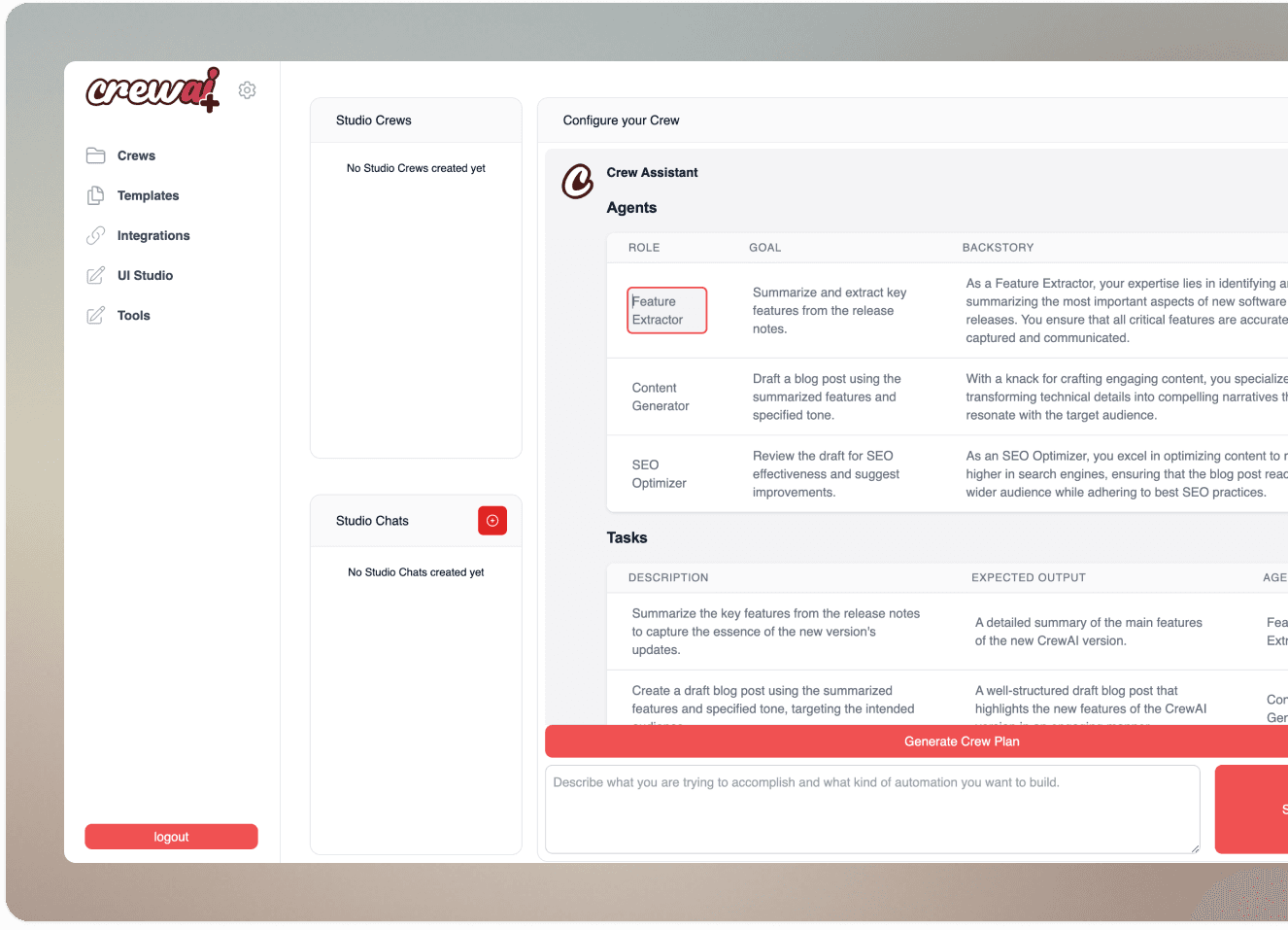
CrewAI structures multi-agent systems around defined roles rather than a graph or a conversation, with each agent in a “crew” assigned a specific responsibility. CrewAI is designed for role-based multi-agent orchestration and fits well for automation use cases like content publishing, research pipelines, and workflows where the division of labor between agents maps naturally onto human team roles. CrewAI supports the Model Context Protocol for tool integrations, and its Agent Management Platform handles the full agent lifecycle from development through deployment and monitoring as a managed platform, which matters for teams that want the framework and the operational tooling in one place rather than assembling observability separately.
Fast and flexible workflow building: Through the framework or no-code UI Studio, supports quickly creating multi-agent automations, with options for coding from scratch or using ready-made templates.
Scalable deployment: Deployable on any cloud platform, supporting self-hosted and local options.
App integration: Easily integrates with existing apps and systems, helping teams automate processes without the need for coding expertise.
Human-in-the-loop: Helps incorporate human oversight through AI agent management, ensuring feedback and control throughout automation workflows.
Visibility and analytics: Helps track agent performance, efficiency, and return on investment (ROI) with detailed insights, enabling continuous optimization of automated processes.
Best for: Teams building coding and research agents or content workflows where role-based task division is a natural fit.
6. OpenAI Agents SDK
OpenAI Agents SDK is lightweight and model-driven for quick setups, taking a simpler approach than graph-based frameworks: define an agent, give it tools, let the model drive the loop. It trades the explicit control LangGraph or Microsoft Agent Framework offer for more agent autonomy and faster time to a working prototype.
Best for: Teams that want to ship a tool calling agent quickly without committing to a heavier orchestration model upfront.
7. Claude Agent SDK
Claude Agent SDK takes a tool-use-first approach: agents are Claude models equipped with tools, including the ability to invoke other agents as tools, with a deliberately simple agent loop that receives a prompt, calls tools as needed, and returns a structured response. That simplicity is the design point rather than a limitation, and it supports file access and code execution patterns suited to research agents and technical agent implementations where the task is well-defined but the tool surface is broad. Best for: Teams building agents where tool-use reliability matters more than a heavily customized orchestration layer.
8. Mastra
Mastra is a TypeScript-first agent framework for building applications, filling a gap most of this list doesn’t address: Mastra integrates natively with the Model Context Protocol and ships built-in observability, giving JavaScript and TypeScript teams a framework that doesn’t require bridging to a Python-first ecosystem. Mastra provides persistent agent memory through its Memory Gateway, handling the same long-term state problem LangGraph and Microsoft Agent Framework solve, letting the same teams that build the frontend also build the agent layer without introducing a second language into the stack. Best for: Typescript-first agent framework adoption for teams that don’t want to introduce a Python service just to run agents.
9. LlamaIndex Workflows
LlamaIndex, long known for retrieval-augmented generation, extended into agent orchestration with Workflows. LlamaIndex Workflows supports Python and TypeScript for event-driven orchestration, structuring agent logic around events rather than a fixed graph, which suits agents whose next step depends on unpredictable external triggers rather than a predetermined sequence. Best for: Teams already using LlamaIndex for retrieval that want to expose agents without adopting a second, unrelated framework for orchestration.
Human in the Loop and Governance for Production Agents
A framework that runs cleanly in a demo and a framework that’s safe to run in production against real systems are not automatically the same thing. Enterprises require governance and compliance when adopting multiple AI agents and tools, and that requirement doesn’t disappear because the framework layer is solved. Identity integration and access control are essential for enterprise AI governance. A framework can manage an agent’s reasoning perfectly and still leave a gap if nothing downstream of it enforces which tools that agent is actually allowed to call. Guardrails prevent malicious inputs and restrict tool access, and audit logging and policy enforcement enhance visibility in AI governance frameworks, giving a security team the ability to answer, after the fact, exactly what an agent did and under whose authorization. Agent frameworks provide reliable debugging through execution traces and logs. Tools like Langfuse capture, visualize, and analyze agent traces at the framework level, which helps diagnose why an agent made a specific decision and track agent quality over time. That’s necessary but not sufficient for production-grade deployment: a framework-level trace shows what the agent decided to do. It doesn’t show whether the infrastructure downstream of that decision actually enforced a boundary, which is a separate layer most framework documentation doesn’t cover. The gap is widest for coding agents running on developer laptops. They often connect to tools directly and never pass through a central gateway, so neither the framework trace nor the gateway logs see what they did. This is also where an AI Skills Registry becomes relevant for teams running more than a handful of agents: a way to centrally track which capabilities are approved for use, by which agents, rather than each team independently wiring up its own tool access and losing track of what’s actually running. As multi-agent setups scale past a single team’s agents into an organization running many of them across many frameworks, that central visibility becomes the actual governance bottleneck, not the framework choice itself.
Where Obot Fits: The Control Plane Under Any Framework
Obot isn’t another agent framework, and it doesn’t compete with any of the ones above. It’s an enterprise AI control plane that sits underneath them. Obot lets you define what agents can reach, choose where they run, and prove what they did. The framework keeps doing what it does well: orchestration, state, and memory. Obot covers what the framework leaves open, in three places. At the gateway, every MCP connection is checked against policy. On developer devices, Obot Sentry sees and enforces what local coding agents do, even when they never route through a gateway. In hosted environments, agents run contained under the same policies. Every action, in every place, lands in one audit record.
Tool-level access control. Admins decide which users and agents can reach which MCP servers. Several servers can be composed into a single governed endpoint that exposes only the tools a given agent needs, so a research agent and a finance agent can draw from the same catalog with different boundaries. Centralized authentication. OAuth flows and credentials are handled at the gateway rather than scattered across agent codebases, with credentials isolated per user. Coverage on developer devices. Coding agents like Claude Code, Codex, and Cursor often run on a developer’s laptop and call tools directly. Obot Sentry gives security teams visibility into what those local agents do and can enforce policy on them, closing a gap that a gateway alone can’t see. Hosted environments. Teams can run agents like Claude Code in hosted environments managed through Obot, so the agent itself executes inside a contained boundary under the same policies as everything else. Audit logging. Every MCP request and response through the gateway is recorded, along with agent activity on devices and in hosted environments. This is the after-the-fact record a framework-level trace can’t provide on its own: not just what the agent decided to do, but what actually reached the tool, where it ran, and under whose identity. One catalog across teams. Obot’s MCP and Skills Registries give the organization a single list of approved servers and skills. Teams on different frameworks all draw from the same approved set instead of each wiring up tool access independently. Model access, governed the same way. Obot’s LLM Gateway proxies providers including OpenAI, Anthropic, Amazon Bedrock, and Azure, and records requests, token usage, and cost alongside MCP activity. The practical result is that framework choice can stay with each team while governance stays consistent across the organization, wherever agents run. A team can move from one framework to another without rebuilding its access policies, because those policies live in Obot, not in the agent code. Obot is MIT licensed and can be self-hosted on your own infrastructure or run as a managed Obot Cloud deployment.
Orchestration model. Decide whether the task needs explicit graph control for predictability, or whether a lighter, model-driven agent loop gets you to production faster with acceptable risk. This is the single choice that most determines which framework fits, more than any feature checklist. Multi-agent support. Not every project needs it, but multi-agent support varies significantly between frameworks built for a single agent with tools and frameworks built from the ground up for inter-agent communication and coordination. Protocol support. Confirm MCP support is native rather than a community adapter, and check A2A support directly against current release notes if the deployment will span multiple frameworks or need to interoperate with agents your organization doesn’t control. Production readiness. Deploy AI agents with a framework that offers session-based state management, checkpointing, and structured tracing, not just a working prototype loop. The gap between a framework that runs in local testing and one that produces production-ready agents is usually the deciding factor for teams past their first agent, and it’s the actual bar for building production agents rather than demos. Programming language. Match the framework to the team’s existing stack. Typescript-first agent framework options exist now specifically so a JavaScript team doesn’t have to introduce a separate Python service. Community and maintenance status. Confirm the framework is under active development, not in maintenance mode the way AutoGen and Semantic Kernel now are. A framework’s GitHub activity and its vendor’s migration guidance both signal where new development is actually going. Governance layer. Decide where tool access, authentication, and audit logging will be enforced before you pick a framework, not after. Account for every place agents run: through a gateway, on developer laptops, and in hosted environments. Putting that layer in a control plane such as Obot, rather than in each framework’s own configuration, means the decision doesn’t have to be revisited every time a team adopts a different framework.
FAQ
What is the difference between an AI agent framework and an AI agent?
An AI agent is the entity that perceives, decides, and acts on a goal. An AI agent framework is the software layer that provides the reusable components, orchestration, memory, and tool-calling infrastructure an agent needs, so a team isn’t building all of that from scratch for every agent it deploys.
Is Microsoft AutoGen still a good choice for new projects?
Not for new development. Microsoft Agent Framework reached general availability in April 2026 as the official successor to AutoGen and Semantic Kernel, and both predecessor projects are now in maintenance mode, receiving security patches but no new feature development. New projects on the Microsoft stack should start with Agent Framework directly.
Which AI agent framework has the best Model Context Protocol support?
Support is now common rather than exceptional: LangGraph, Microsoft Agent Framework, CrewAI, Google ADK, and Mastra all support MCP, several natively in core rather than through a third-party adapter. Confirm the specific integration depth against current documentation, since this is one of the fastest-evolving parts of each framework.
What is the difference between LangChain and LangGraph?
LangChain is the broader toolkit and integration ecosystem for building LLM applications. LangGraph, built by the same team, is a more specialized framework for stateful, graph-based multi-agent workflows requiring explicit control over execution paths, cycles, and checkpointed state. Many teams use both together.
Do I need a multi-agent framework, or is a single-agent framework enough?
It depends on whether the task decomposes naturally into specialized roles. A single well-scoped agent with good tool access handles most straightforward automation. Multi-agent orchestration earns its complexity when a task genuinely benefits from specialized agents collaborating, not as a default architecture choice.
What should enterprise teams check beyond the framework itself?
Identity integration, access control, and audit logging wherever an agent actually calls a tool. A framework manages the agent’s reasoning and orchestration, but it generally doesn’t enforce which tools an agent is authorized to call in production. It also doesn’t see agents that run on developer laptops or outside a central gateway. That enforcement belongs in a separate control layer, such as Obot, which applies the same policies and audit trail to every agent regardless of the framework it was built on or where it runs.
Does Obot replace an AI agent framework?
No. Obot works alongside frameworks rather than replacing them. The framework builds and runs the agent’s logic. Obot defines what that agent can reach, controls where it runs, and proves what it did. Agents built on any MCP-compatible framework connect through Obot’s MCP gateway for authentication, tool-level access control, and audit logging. Obot Sentry extends that coverage to coding agents on developer devices, and hosted environments let teams run agents inside a contained boundary under the same policies.










.png)