The MCP Maturity Model: Full Framework Now Available
Download the full Enterprise MCP Playbook for detailed maturity stages, architecture patterns, and practical guidance for scaling MCP across your organization. Click here to get your free copy.
A few weeks ago, I shared a post on LinkedIn with some initial thoughts on an MCP maturity model after a panel discussion at GitHub Universe. The response was really positive, I heard from lots of old friends from the Kubernetes world about how similar this felt to what we went through in adopting containers. But I also heard from IT leaders, platform engineers, and enterprise architects working on AI adoption and MCP specifically saying “this is exactly what we need to make sense of where we are and where we’re headed.”
That initial post outlined four stages at a high level. Today, I’m excited to share the complete framework: a comprehensive guide that walks through each stage in detail, with practical checklists, implementation guidance, and clear progression criteria.
Why This Matters Now
MCP adoption is accelerating faster than anyone predicted. What started as a developer productivity tool has exploded into mainstream enterprise conversation. ChatGPT has fully embraced MCP support. The official MCP Registry is growing rapidly. Organizations everywhere are discovering that MCP usage is already widespread in their companies—often far more than leadership realizes.
But here’s what we keep hearing at Obot: “We know MCPs are being used. We see the value. But how do we go from chaotic experimentation to enterprise-scale deployment without killing momentum?”
The maturity model answers that question.
The Four Stages: A Quick Recap
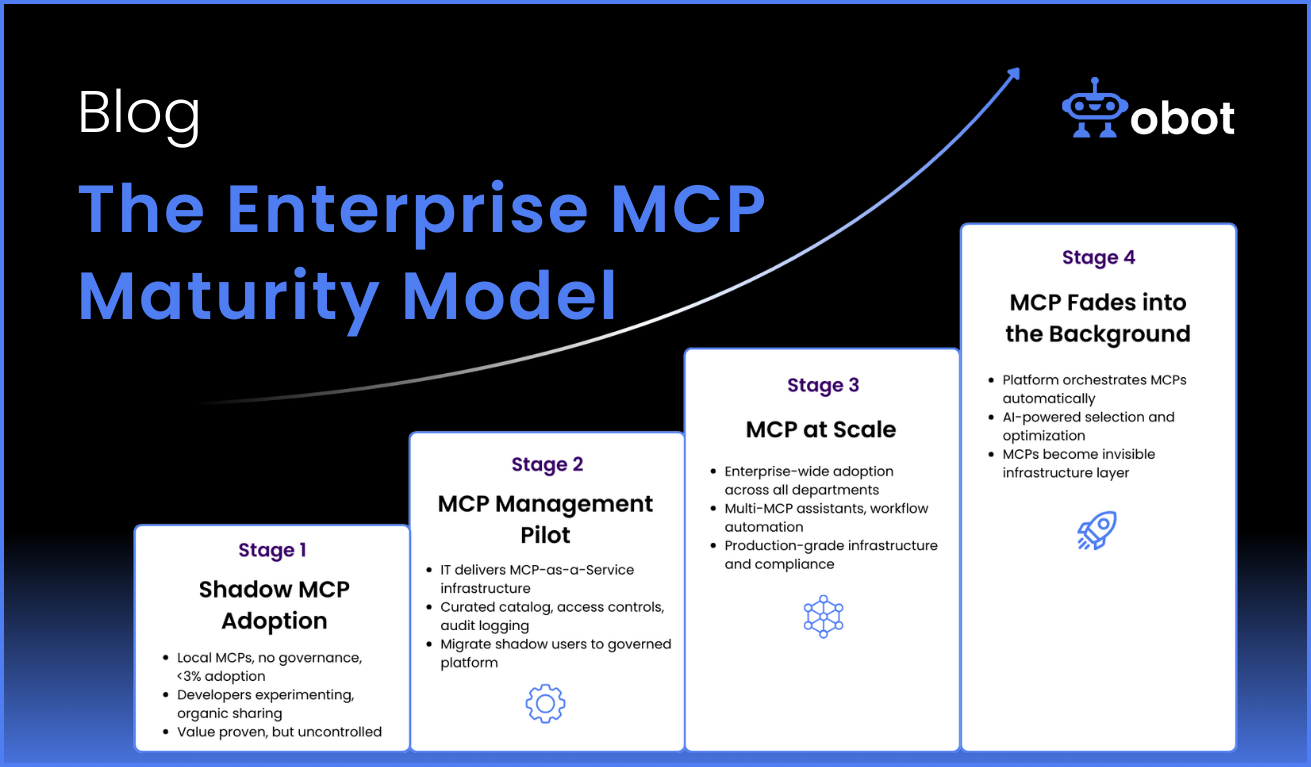
The model describes four distinct stages organizations move through:
Stage 1: Shadow Adoption – Organic, uncontrolled MCP usage across the organization. This isn’t just a handful of people—it’s often hundreds of developers and early adopters using MCPs locally with Cursor, VS Code, and Claude Desktop. IT usually discovers this is happening rather than planning for it.
Stage 2: Managed Pilot – IT’s response to shadow adoption. You’re providing governed infrastructure with a curated catalog of 15-20 core, approved MCPs, implementing access controls, and migrating shadow IT users to a managed platform. The challenge is making the managed approach better than what people are already doing.
Stage 3: Scaled Deployment – Expansion to hundreds or thousands of users across all departments. Business users build multi-MCP assistants and share them across teams. Someone in sales builds an assistant that checks inventory, updates Salesforce, and drafts proposals—then shares it with the entire team. This is where MCP transforms from developer tool to organizational capability.
Stage 4: AI-Powered Integration Platform – The platform itself becomes intelligent. Users describe what they want to accomplish, and the platform figures out which MCPs to use, guides them through assistant creation, and learns from successful patterns to recommend better approaches. Complexity fades into the background.
What’s New in the Full Framework
The complete maturity model goes far beyond the initial outline:
Detailed Stage Characteristics
Each stage now includes comprehensive descriptions of what it actually looks like in practice. I tried to focus on real patterns we’re seeing at organizations using Obot and across the industry. What does “scaled deployment” mean for your infrastructure? Your security team? Your users? The framework answers these questions with specifics.
Progression Criteria and Readiness Checklists
When are you ready to move to the next stage? I always felt this was a key element of successful frameworks in the cloud native space. I wanted the framework to provide explicit criteria and comprehensive checklists for each stage. I tried to make them as specific, and actionable as possible, so that teams could track where they were and what they needed to acomplish to move on to something else.
Sample from Stage 2 Checklist:
- MCP Gateway deployed and operational
- Identity provider integration configured and tested
- 10–20 MCP servers curated and tested
- Role-based access control configured
- Audit logging operational
- Platform team identified (1–3 people)
- On-call rotation established
Implementation Guidance
What infrastructure do you actually need at each stage? The framework breaks down:
- Architecture requirements – What does Stage 2 infrastructure look like vs. Stage 3?
- Team resources – Who needs to be involved and what are their roles?
- Timeline expectations – How long does progression typically take?
- Common pitfalls – Where do organizations get stuck and how do you avoid it?
Real-World Context
The framework incorporates patterns we’re seeing across dozens of Obot deployments and hundreds of conversations with enterprise teams. It reflects what’s working, what’s challenging, and what matters most at each stage.
Key Insights from the Full Framework
A few things became clear as we developed the complete model:
You Can’t Skip Stages
This is probably obvious to anyone who has worked in IT for a while, but the process really matters. Organizations that try to jump from Stage 1 to Stage 3 get stuck. They build infrastructure that’s too complex for their current needs, slow down adoption, and lose momentum. Stage 2 looks different from Stage 3 for good reasons—trying to build Stage 3 infrastructure when you need Stage 2 capabilities just adds unnecessary complexity.
Stage 1 Is Already Happening
If you’re reading this, or interested in the guide, you probably already know that shaddow adoption of MCPs is common in most organizations. Given that, it’s important to focus on discovery and bringing people into the project. The question is whether you discover shaddow adoption early or late, and whether you respond by embracing it (with governance) or trying to shut it down. The organizations seeing the most success are the ones who discovered their shadow MCP usage, recognized the productivity gains, and decided to provide proper infrastructure rather than ban it.
The Transition from Stage 2 to Stage 3 Is the Big Lift
Getting from chaotic adoption to managed pilot (Stage 1 to Stage 2) is relatively straightforward—it’s mostly about standing up infrastructure and defining initial policies. We see teams make this jump in just a few weeks using Obot as a gateway and registry. But going from pilot to scaled deployment (Stage 2 to Stage 3) is where organizations face the biggest challenges. This transition requires:
- Shifting from developer-focused to business-user-enabled
- Building multi-MCP assistant capabilities, and integrating with more clients
- Evolving from “IT provides MCPs” to “anyone can build assistants”
- Scaling infrastructure to handle diverse usage patterns
- Implementing behavioral controls, not just access controls
The framework provides detailed guidance specifically for this transition because this is where most organizations will spend the most time and face the most challenges.
Stage 3 Is a Great End State
You don’t need to reach Stage 4 to be successful. Stage 3—scaled deployment with hundreds or thousands of users building and sharing assistants across the organization—represents tremendous value. Stage 4 is about adding platform intelligence to make building even easier. It’s aspirational, not mandatory. We are still building a lot of what I’m talking about in stage 4 in Obot. It’s the kind of thing I’m hoping we’ll start seeing in 2026 or 2027.
How to Use This Framework
The maturity model is a practical tool, not academic theory. Here’s how to use it:
Assess where you are. Use the stage characteristics and assessment questions to identify your current stage. Most organizations are in Stage 1 (discovering shadow adoption) or Stage 2 (building managed infrastructure).
Understand what’s next. Read the next stage description in detail. What infrastructure will you need? What capabilities? What team resources? This helps you plan and budget appropriately.
Use the checklists. The readiness checklists tell you when you’re ready to progress. Don’t move to the next stage until you’ve addressed the critical items for your current stage.
Set realistic timelines. Stage 1 to Stage 2 typically takes 1–3 months. Stage 2 to Stage 3 takes 3–6 months. Stage 3 to Stage 4 takes 6–12 months. Plan accordingly and set stakeholder expectations.
Focus on foundations. Each stage builds on the previous one. Strong foundations in Stage 2 (identity integration, audit logging, governance processes) make Stage 3 much easier. Trying to retrofit these later is harder and more disruptive.
What’s Included in the Full Framework
The complete maturity model includes:
- Detailed descriptions of all four stages
- Progression criteria and readiness indicators
- Comprehensive checklists for each stage (infrastructure, governance, operations, metrics)
- Implementation guidance covering architecture, security, access control, and change management
- Timeline expectations and resource requirements
- Common pitfalls and how to avoid them
- Success metrics for each stage
- Real-world examples and patterns
Get Your Free Enterprise MCP Playbook
Take the next step in operationalizing the MCP Maturity Model: Obot’s Enterprise MCP Playbook outlines detailed stage definitions, architecture patterns, governance checklists, and guidance on moving from early experiments to a fully scaled, AI-ready platform.
📑 Click here to get your free copy.
The Same Pattern, Again
What strikes me most about this maturity model is how familiar it is. We’ve seen this progression before with cloud adoption, containerization, SaaS. The pattern is always the same:
- Developers discover something that makes them more productive
- Usage spreads organically through the organization
- IT discovers shadow adoption and faces a choice: ban it or govern it
- Successful organizations provide managed infrastructure that’s better than the shadow version
- Adoption scales when the managed approach removes friction rather than adding it
- Eventually, the technology fades into the background as it becomes standard infrastructure
MCP is following this exact pattern. We’re at the early stages now—most organizations are discovering Stage 1 or building Stage 2 infrastructure. The ones who move quickly will have significant advantages.
Where Obot Fits
The Obot MCP Gateway fits this model incredibly well. We are continually updating it based on what we’re hearing from users, and that is all reflected in the patterns I share in this guide:
For Stage 2: Out-of-the-box MCP gateway with curated catalog, identity provider integration, role-based access control, and audit logging. You can go from zero to managed MCP infrastructure in days, not months.
For Stage 3: Built-in chat interface for building multi-MCP assistants, project sharing capabilities, task scheduling, and knowledge integration. The platform is designed to enable business users, not just developers.
Looking toward Stage 4: We’re actively developing platform intelligence features—assisted assistant building, intent-based tool selection, and smart recommendations based on usage patterns.
But more importantly, we built Obot to be open source because we believe MCP infrastructure should be transparent and extensible. Organizations need to understand and control this layer. Proprietary black boxes don’t work for enterprise infrastructure.
Get the Complete Framework
The full MCP Maturity Model is available now as part of our Enterprise MCP Playbook. It includes:
- Complete stage descriptions with real-world context
- Readiness checklists and progression criteria
- Implementation guidance for each stage
- Architecture patterns and infrastructure requirements
- Timeline expectations and resource planning
- Success metrics and measurement strategies
You can download the complete playbook here.
Let’s Talk
If you’re working through MCP adoption at your organization, I’d love to hear where you are in the maturity model and what challenges you’re facing. We’re learning constantly from the organizations deploying Obot and navigating these stages.
- Where do you see your organization in the maturity model?
- What’s your biggest challenge with MCP adoption right now?
- Are you discovering shadow adoption or actively building managed infrastructure?
The conversations we’ve had over the past few weeks since the initial post have been invaluable in refining this framework. The more we can share real-world experiences, the better this model becomes for everyone.
Drop a comment or reach out directly—this framework will continue to evolve as MCP adoption matures, and your input helps make it better.
Want to see how Obot implements these maturity model patterns? Check out the platform or join our community on GitHub to see how we’re building the enterprise control plane for MCP.
Ready to move from shadow adoption to managed infrastructure? Contact us to discuss how Obot can help your organization progress through the maturity model.