If you’ve been building with MCP for any length of time, you’ve probably already discovered that the protocol works exactly as advertised, and that working as advertised creates its own set of problems. The MCP architecture that solved the N×M integration nightmare has generated a new category of friction: context bloat from over-connected servers, static credentials scattered across developer laptops, and autonomous agents accumulating tool access faster than any governance team can track.
This is what a maturing protocol looks like in practice. The early adopters have moved past “does it work” and into “how do we run this responsibly at scale.” Security researchers are finding real vulnerabilities. Compliance teams are asking questions nobody planned for. The organizations navigating this well aren’t the ones who adopted fastest. They’re the ones who built a framework for deciding when the protocol fits the problem and when it doesn’t.
Why MCP Exists: The N×M Problem Nobody Wants to Maintain
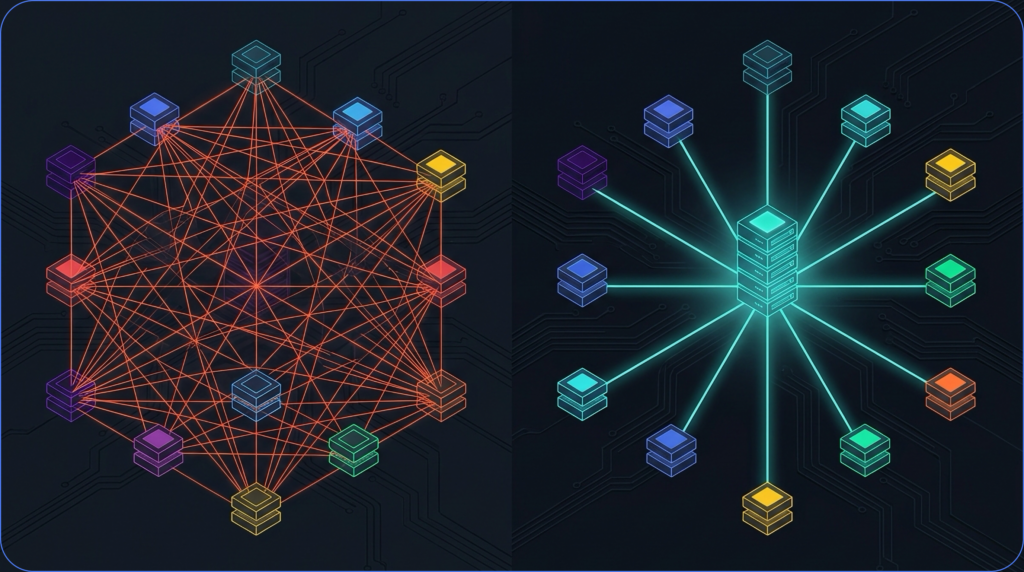
Before MCP, every new AI model that needed to talk to a new tool required a new custom integration. Not reused. Not shared. New. Five AI models and twenty tools meant up to a hundred bespoke connections to build, test, document, and keep current as APIs changed. The engineers maintaining those integrations were not having fun.
According to the MCP vs A2A analysis at philippdubach.com, MCP’s core design goal was to make integration complexity linear rather than quadratic. One MCP server for Salesforce. Any compatible host can use it. The combinatorial explosion stops.
MCP, built on JSON-RPC 2.0, gives LLMs machine-readable tool discovery, structured function signatures, schema-validated inputs, and predictable return types. The model doesn’t just know a tool exists; it knows exactly how to call it and what to expect back. CLI tools were designed for humans operating terminals. That’s a fundamentally different capability, and it’s what makes autonomous agent workflows reliable rather than brittle.
The scale of adoption confirms the problem was real. By December 2025, Anthropic counted 10,000+ active public MCP servers and 97 million monthly SDK downloads across Python and TypeScript alone. When Sam Altman endorsed MCP on March 26, 2025, OpenAI’s adoption followed across their Agents SDK, Responses API, and eventually ChatGPT itself. A competitor adopting your protocol is a strong signal that the underlying problem was genuine.
Platforms like Latenode, with 1,200+ app integrations, illustrate where standardization becomes non-negotiable. At that scale, hand-rolling integrations per model isn’t a strategy; it’s technical debt accumulating faster than any team can service it.
Try Obot Today
⬇️ Download the Obot open-source gateway on GitHub and begin integrating your systems with a secure, extensible MCP foundation.
The Real Friction: Context Bloat and the MCPorter Response
MCP adoption ran faster than MCP discipline. Practitioners started wiring up server after server and then hit a wall that had nothing to do with the tools themselves.
Every MCP server you connect declares its tools in the context window. Connect enough servers, and a meaningful portion of your available context is consumed by tool declarations before the model has processed a single user query. Token budgets that should be doing reasoning work are instead holding schema definitions for tools the agent may never call in a given session. A LocalLLaMA community discussion captures the pattern clearly: practitioners are trending away from large MCP server configurations and back toward CLI precisely because CLI consolidates tool surface area, requiring only one tool call regardless of how many underlying operations get executed.
The MCP Architecture Trade-off MCPorter Surfaces
MCPorter is the community’s pragmatic response to this tension. Wrap MCP server functionality back into CLI commands, so the model can batch operations into scripts rather than executing sequential tool calls. According to practitioners in that same thread, the efficiency gains are real in specific scenarios. A Playwright workflow requiring ten sequential interactions, or a weather comparison across multiple locations, becomes a single script the model writes and executes rather than a chain of discrete tool invocations.
But the trade-off MCPorter reveals matters more than the tool itself. Wrapping MCP servers into CLI commands means abandoning the native authentication and structured security controls that MCP was designed to provide. That works fine for individuals with full control over their environment. It creates serious problems in enterprise contexts where agents must operate within authentication policies, data residency constraints, and audit requirements.
CLI efficiency arguments hold in open, developer-controlled systems. They stop holding the moment a compliance officer asks how credentials are being handled, or when an agent needs to operate within a corporate network that treats code execution environments with external network access as an unacceptable risk. Some integrations genuinely belong as MCP servers, and some belong as CLI tools. The harder organizational question is who governs that distinction, and how.
The Decision Framework: When MCP Wins, When CLI Wins
The MCP Architecture Decision Framework
The right tool depends on three variables: how well the model already knows the tool, how complex the schema is, and how much governance the environment requires.
When MCP wins:
The tool is custom and not in the model’s training data. As one LocalLLaMA practitioner framed it, gh is probably trained in. my_custom_command_line is not. MCP bundles instructions and schema into a form the model can invoke correctly on the first call, without exploratory turns.
The input schema is genuinely complex. A CLI flag cannot cleanly express a list of structured data objects. Forcing it to do so means the model writes a file, then calls a separate tool to validate it. MCP handles that in one call.
You’re standardizing across a large ecosystem with multiple teams and multiple AI clients. The N×M problem reasserts itself at scale. MCP keeps integration complexity linear.
Security, authentication, and audit controls are non-negotiable. Wrapping MCP servers into CLI commands means abandoning the native permission controls that MCP was designed to provide. In enterprise environments, that trade-off is not available.
When CLI wins:
The tool is well-known and already in the model’s training data. git, gh, standard Unix tooling: the model knows the interface. Adding an MCP server adds context overhead without adding capability.
The toolset is large enough that upfront schema loading would consume context budget before reasoning begins. CLI’s progressive discoverability model handles scale better.
The workflow is a one-off or purely developer-facing, running on infrastructure the developer fully controls.
The practitioner sweet spot, according to the same LocalLLaMA discussion, is a small, fixed set of MCP servers covering external connectivity, layered with Skills for procedural orchestration. Two or three MCP servers handling the integrations that genuinely need structured schemas and auth controls, with CLI handling everything the model already knows how to use. That combination respects context budgets, preserves security posture, and keeps the mcp architecture coherent rather than sprawling.
The Enterprise Layer: Where Governance Becomes the Actual Problem
Individual practitioners can make sensible MCP architecture decisions for their own workflows. That calculus works at one developer. It stops working at fifty. At five hundred, it becomes a liability.
The MCP Maturity Model maps this trajectory clearly. Teams discover MCP, start connecting servers, share configurations, and before long you have agents running across multiple teams with no shared understanding of what’s connected to what. The progression from “developer convenience” to “autonomous agents managing their own tool access” happens faster than governance frameworks can respond.
The Security Posture Nobody Planned For
Astrix Security’s research, cited in the MCP vs A2A analysis, found that 53% of MCP servers rely on static credentials rather than OAuth. Read at enterprise scale, that’s an attack surface inventory. Every static credential in a config file is a secret that doesn’t rotate, doesn’t scope to least privilege, and often isn’t audited when someone leaves the team.
CVE-2025-6514 made the exposure concrete. A shell injection vulnerability in the mcp-remote npm package put over 437,000 installations at risk. This wasn’t a theoretical weakness in a poorly maintained hobby project. It was a critical vulnerability in infrastructure that organizations had already deployed.
TCP/IP had early-stage security problems too, and nobody calls that fatal in retrospect. But those problems caused real incidents before the posture matured. MCP is in that same adolescent window, and the organizations building on it need to decide whether they’re going to govern it proactively or reactively.
Governance as Infrastructure
Indigo.ai’s analysis of enterprise context engineering frames the governance challenge correctly: the real bottleneck in orchestrating AI agents in enterprise contexts lies in capabilities, specifically in controlling direct actions on information systems. MCP standardizes those actions. Governance determines whether that standardization is a safety feature or just a uniform attack surface.
A centralized control plane changes this dynamic entirely. The Obot MCP Gateway is built around exactly this problem: organizations need a single layer where every MCP connection is authenticated via OAuth rather than static credentials, every tool invocation is logged, and access control is enforced by policy rather than developer convention. That’s not a constraint on what teams can build. It’s the infrastructure that makes it safe to let them build faster.
Security leaders have a word for ungoverned MCP deployments: shadow AI. The path out isn’t slowing adoption. It’s making governed adoption the path of least resistance.
Context Engineering: Beyond Tools to Operational Capability
Most organizations treating MCP as a tool-calling protocol are solving the right problem with the wrong mental model. MCP is not primarily about giving agents more tools. It’s the standardization layer that determines how AI agents interact with live enterprise data on demand, rather than reasoning over context that was already stale when the session began. Context Engineering & Model Context Protocol frames the distinction precisely: the typical benefit isn’t just reduced technical debt on integrations, it’s that AI agents use updated data “on demand” instead of working on an overly broad and obsolete context.
The Workflow-Agent Gap in MCP Architecture
Not all AI deployments have the same context demands, and collapsing that distinction is why organizations end up over-engineered in some places and dangerously under-equipped in others.
The MCP Maturity Model draws the line cleanly: workflows typically need less sophisticated context management than true agents. A workflow is structured and linear; context requirements can be anticipated, scoped, and loaded in advance. A true agent is autonomous and dynamic. It decides what to do next based on what it finds, which means its context requirements are not predictable at session start. It needs to pull information when it needs it, not carry everything it might conceivably need from the beginning.
That distinction has direct implications for how you provision tool access. A workflow agent can afford a fixed, pre-loaded tool set. An autonomous agent running against live enterprise systems cannot. Loading every possible tool schema upfront consumes context budget that should be doing reasoning work.
The harder design problem is deciding which tools an agent should be able to reach, at what moment, under what conditions. That’s an infrastructure question, not a protocol question. The organizations treating MCP as foundational plumbing are building something durable. The ones treating it as a connector catalog are accumulating complexity they’ll eventually have to unwind.
The Consolidation Phase Has Begun
MCP is delivering on its core promise. The N×M integration problem is real, the adoption numbers confirm the protocol resonates, and the developer community is actively working out where it fits and where it doesn’t.
The friction points documented here aren’t reasons to slow down. They’re the map. Context bloat is a solvable design problem. Static credentials are a governance gap, not a protocol flaw. The organizations that treat these as infrastructure questions rather than annoyances will build something durable.
What separates them is a decision to govern proactively. Every MCP connection authenticated. Every tool invocation logged. Access controlled by policy, not developer convention. The Obot MCP Gateway exists precisely for this moment, when adoption has outpaced oversight and the cost of ungoverned sprawl is becoming visible.
The teams getting this right are thinking about MCP architecture as foundational plumbing, not a feature catalog. That discipline, built early, is what turns an adolescent protocol into enterprise infrastructure.