Developers building with Claude Code are converging on the same solutions without talking to each other. Across Hacker News threads and engineering blogs, teams are independently hand-rolling CLAUDE.md governance files, building state bridges to survive context loss between sessions, layering in verification steps to catch confidently wrong outputs, and constructing parallel orchestration schemes to stop themselves from becoming the bottleneck. Nobody coordinated this. The patterns emerged because the underlying problems are identical everywhere, and because the AI agent architecture powering these tools shipped without the governance layer those problems demand.
The AI Agent Architecture Problem Nobody Planned For
One developer, writing on Hacker News about daily Claude Code use across Docker configs, shell scripts, and API development, put the core discipline plainly: a good CLAUDE.md file with strict rules is the difference between a useful agent and an over-engineering machine that generates plausible-looking code that is subtly wrong. That is a governance document. He wrote it himself. Every team is writing their own version.
A second developer, describing why he built a multi-agent coordination layer, laid out the economics with unusual clarity. On the $200/month Claude Code Max plan, the question stops being how to minimize token usage and becomes how to maximize value from tokens already purchased. But his honest summary of the pre-automation state was “babysitting an expensive intern” through two hours and $12 in API costs on a single task. A supervision burden, not a productivity tool.
The $15-$25 per-PR pricing controversy that has circulated through engineering communities crystallizes what the governance gap costs when it finally becomes visible. Teams that hand-rolled their own orchestration and verification layers absorbed those costs in engineering hours, which are easy to overlook. Attach a dollar figure to each pull request review and suddenly the absence of a real infrastructure layer has a line item. The cost was always there. The visibility is new.
What teams are building in isolation, including coordination logic, constraint enforcement, context management, and audit trails, is the infrastructure layer for open source AI agents and commercial tools alike. It should have shipped with the platform. It did not, and engineering organizations are paying for that gap one bespoke workaround at a time.
The Four Failure Modes Developers Keep Rediscovering
Failure Mode 1: Context Loss Across Sessions
Every new Claude Code session starts cold. The agent has no memory of the architectural decisions made yesterday, the constraints encoded two sessions ago, or the dead ends already explored last week. Developers have converged on the same stopgap: handwritten context documents that reconstruct project state at the start of each session. The Claude Code best practices documentation dedicates an entire section to “resume conversations” and “manage context aggressively,” confirming the pattern is universal enough to warrant official guidance. That guidance exists because the platform doesn’t solve the problem natively. Teams solve it manually, every time, for every project.
Failure Mode 2: Architectural Drift
Left unconstrained, the agent optimizes for completeness rather than simplicity. Practitioners report that without explicit guardrails, Claude Code will introduce abstractions, indirection layers, and generalization schemes that weren’t requested and aren’t needed. One developer writing in a Hacker News thread about daily infrastructure work described this directly: the agent “over-engineers everything if you don’t rein it in.” The fix, in his case, was a governance document with explicit constraints. That document is doing the work that the platform’s own AI agent architecture should handle by default.
Failure Mode 3: Unverified Outputs
Confident wrongness is the most dangerous failure mode because it costs time in proportion to how convincing the output looks. The same practitioner described code that is “plausible-looking” but “subtly wrong,” adding a pointed warning: never trust outputs on anything you cannot verify independently. In practice, this means developers must maintain enough domain expertise to audit every significant output, which preserves a verification burden that the productivity gains were supposed to reduce. The agent accelerates generation. It does not accelerate validation.
Failure Mode 4: Human as Bottleneck
A developer building a multi-agent coordination layer on Hacker News described the pre-automation state with precision: every step required human intervention, correcting course, enforcing constraints, switching between projects to issue the next instruction. His experience with a browser automation task, two hours of active supervision at $12 in API costs for a single workflow, crystallized the problem. The agent was productive. The developer was not. For open source AI agents and commercial tools alike, the governance gap converts a force multiplier into an interrupt queue, and the human ends up managing the tool rather than directing the work.
The Cottage Industry of Homegrown Fixes
The patterns didn’t emerge from conference talks or platform documentation. They emerged from developers hitting the same walls independently and writing their own way around them. The result is a cottage industry of governance tooling that lives in markdown files, JSON configs, and Git branch strategies, spread across engineering teams who mostly don’t know each other’s solutions exist.
The CLAUDE.md as Onboarding Manual
The most widespread pattern is the CLAUDE.md file, a persistent document dropped into project repositories to tell the agent who it is, what constraints it operates under, and what anti-patterns to avoid. Anthropic’s own context engineering documentation describes these files as being “naively dropped into context up front,” which is a precise description of the mechanism and an implicit acknowledgment that something more sophisticated doesn’t yet exist at the platform level. Teams are writing these files from scratch, encoding institutional knowledge about their codebase in a format the agent can consume at session start. In practice, a well-maintained CLAUDE.md is an onboarding manual for a new hire who forgets everything overnight.
Scratchpads, State Files, and the Memory Stack
Below the CLAUDE.md layer, two more patterns have hardened into convention. The first is the NOTES.md scratchpad: a within-session file the agent uses to track progress across complex tasks, maintaining dependencies that would otherwise dissolve across dozens of tool calls. Anthropic’s context engineering documentation validates this directly, citing it as a recognized pattern for tracking “critical context and dependencies that would otherwise be lost.” The second is the shared JSON state file as a cross-agent communication bridge. One founder, writing about an autonomous multi-agent loop, describes the JSON file as “the only bridge” between a Commander agent and an Executor agent, noting that native inter-agent APIs had known conflicts that made them unreliable. Flat files became the infrastructure layer by default.
Parallel Isolation and Role Protocols
For teams running multiple agents concurrently, two more patterns have emerged. Git worktrees provide session isolation: separate working directories that allow parallel Claude Code instances to operate without stepping on each other. A senior engineer writing on Reddit described this as “the next evolution” in scaling AI coding work, with teams managing four to eight parallel agents once the workflow discipline is in place. The worktrees solve the isolation problem. The discipline requirement is the tell: this is coordination infrastructure that developers are supplying manually.
The Commander/Executor communication protocol addresses a different failure. Without strict role definition, agents in an autonomous loop drift toward ambiguity; the same founder describes the STEP/RESULT numbered protocol as “non-negotiable,” because without it, “after 2-3 hours you have two agents having a conversation about what happened rather than executing.” Structured communication formats, written by hand, enforced through prompt engineering, are standing in for the orchestration layer that a mature AI agent architecture would provide natively.
Flat Files Over Cloud
For longer-term memory, a clear practitioner consensus has formed around local flat-file systems over cloud knowledge bases. One developer writing about personal operations tooling put the reasoning plainly: Obsidian on the local file system is natively readable by Claude Code, while cloud alternatives like Notion trap content in API structures that are harder for open source AI agents to consume cleanly. The recommendation is structured topic folders and wiki-links, with embeddings deferred until the actual search patterns are understood. Plain markdown wins because it requires no translation layer between the agent and the knowledge store.
Taken together, these patterns constitute an improvised infrastructure stack. Each piece solves a real problem. None of them should require bespoke engineering to exist.
When ‘One Clever Workaround’ Becomes an Engineering Discipline
The patterns documented above are early signals of a structural problem that enterprise organizations have seen before, and paid for before.
The parallel to shadow IT is not accidental. A decade ago, individual teams stood up unauthorized SaaS tools because enterprise software moved too slowly to meet operational needs. The tools were genuinely useful. The proliferation was genuinely costly. IT organizations spent years building governance frameworks around tooling that had already colonized production workflows, often discovering the full scope of exposure only after an incident. The lesson was not that individual teams were reckless. When official tooling leaves a gap, engineers fill it, and the filling accumulates into technical and compliance debt at scale.
The same dynamic is running now, one CLAUDE.md file at a time.
The Staffing Reality Behind Production AI Agent Architecture
The Multi-Agent AI Platform Comparison 2026 makes the organizational scope explicit: successful multi-agent deployments require equivalent investment in orchestration infrastructure, governance frameworks, observability systems, and human oversight mechanisms, regardless of which platform an organization selects. That “regardless” is doing real work. It means the governance burden is not a platform-specific quirk. It is a structural requirement of production-grade AI agent deployments.
Production deployments now draw on five distinct professional roles: LLM engineers designing prompts and agent behaviors, DevOps managing deployment and reliability, data engineers handling context and memory systems, security professionals managing credential and access exposure, and governance specialists ensuring auditability and compliance. The license fee, whether for a commercial platform or infrastructure supporting open source AI agents, is the smallest line item on the actual bill.
Total cost of ownership for AI agent deployments is therefore not primarily a software procurement question. It is a staffing, process, and debt question. And the debt is accumulating invisibly.
Every team that builds its own context management scheme, its own constraint enforcement layer, its own inter-agent communication protocol, is incurring what might be called agent governance debt: the hidden cost of reinventing primitives that the platform should have provided. The debt compounds. When organizational priorities shift, when team members turn over, when audit requirements change, the bespoke governance layer built by one developer in one sprint becomes the undocumented critical infrastructure that nobody fully understands. That is the moment organizations discover the real total cost of the governance gap.
What Pre-Built Infrastructure Actually Looks Like
The senior engineer writing about scaling with Claude Code made one observation that cuts through the productivity debate cleanly: most experienced teams land at four to eight parallel agents as their operating rhythm, and without session isolation that number is simply unmanageable. The worktree strategy works, but it requires workflow discipline that must be maintained manually, by every developer, across every project.
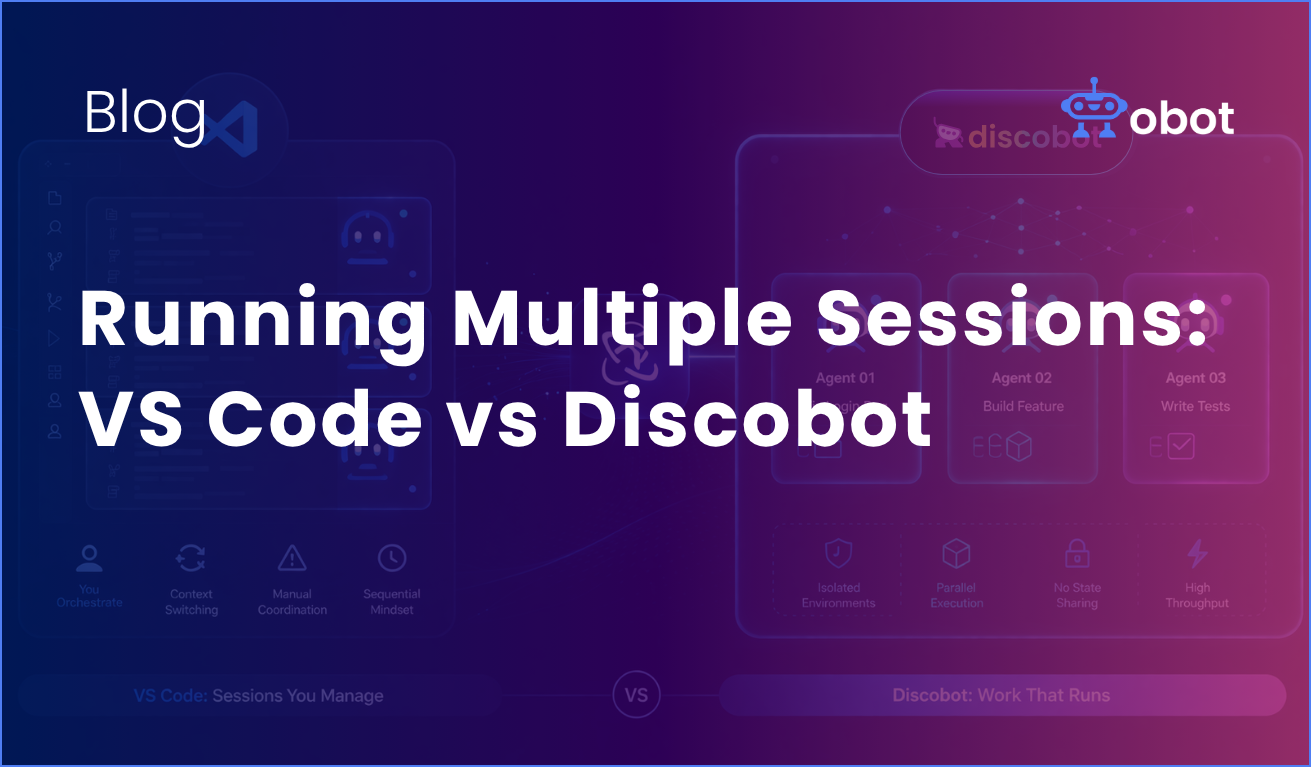
Discobot is built around that specific operational reality. Isolated sandboxes prevent session bleed at the infrastructure layer rather than the convention layer, so two agents working against the same codebase cannot corrupt each other’s state regardless of what a developer does or forgets to do. Parallel execution across multiple repositories is the default mode, not a configuration option that requires git worktree setup and branch discipline to unlock. Live browser previews, built-in terminal access, and SSH connections to external editors are present without any scaffolding work. The environment handles what every team above is currently handling through documented agreements and manually enforced protocols.
The founder who built an autonomous eight-hour loop described his JSON bridge and numbered STEP/RESULT protocol as “non-negotiable.” He’s right that some form of synchronized state management is non-negotiable for parallel agent work. Whether that mechanism lives in a plugin one developer wrote, or in the platform every developer runs on, is invisible when everything works. The difference surfaces when a team member leaves, when a new project starts from scratch, or when a second team wants to adopt the same workflow and discovers the coordination logic is embedded in one founder’s custom zip file. Pre-built infrastructure does not eliminate the complexity of running parallel agents. It eliminates the requirement to reinvent the plumbing before any real work can start.
From Governance Debt to Governance as an Accelerator
The teams pulling ahead right now share a common mindset shift. Governance stopped being the thing that slowed them down and became the thing that made speed sustainable. That distinction sounds abstract until you’ve watched a team spend three weeks untangling agent governance debt because the developer who wrote the original coordination layer left, and nobody else understood what the JSON bridge was doing or why the Commander/Executor numbering scheme existed.
AI Agent Architecture at the Platform Level
Treating governance as infrastructure rather than as documentation changes the organizational calculus entirely. Centralized audit logging means compliance reviews don’t require reconstructing what happened from Git history and Slack threads. Identity-provider integration means agent permissions inherit from the access controls already in place, rather than living in a separate config file that drifts out of sync with HR records. A searchable catalog of approved agent capabilities means developers know what tools are available and sanctioned before they start building, not after security flags a production deployment. The Obot MCP Gateway provides exactly this layer: centralized control, audit trails, and a governed catalog of agent capabilities that makes the approved path the easy path.
The choice in front of most engineering organizations is between paying the governance cost upfront in infrastructure, or paying it later in incidents, rework, and the quiet accumulation of undocumented critical systems.
Building fast and staying secure is a real option. It requires treating the governance layer as a first-class engineering concern rather than a markdown file someone wrote during onboarding. Explore Discobot and the Obot platform at obot.ai to see what that infrastructure layer looks like when it ships with the platform instead of getting reinvented inside every engineering org that wants to move quickly.
The Governance Gap Is an Engineering Decision, Not a Waiting Game
The patterns documented here, from CLAUDE.md files to JSON bridges to Commander/Executor protocols, are signs of a missing infrastructure layer that engineering teams are filling one sprint at a time, accumulating debt that won’t show up on any balance sheet until something breaks.
The teams moving fastest in 2026 have made one common decision: they stopped treating governance as overhead and started treating it as foundation. The AI agent architecture question facing every engineering organization right now is straightforward. Pay the governance cost in advance, with purpose-built tooling like the Obot MCP Gateway that handles coordination and auditability at the platform level, or pay it later in rework, undocumented critical systems, and bespoke plumbing nobody fully understands.
The gap is real. The infrastructure exists.