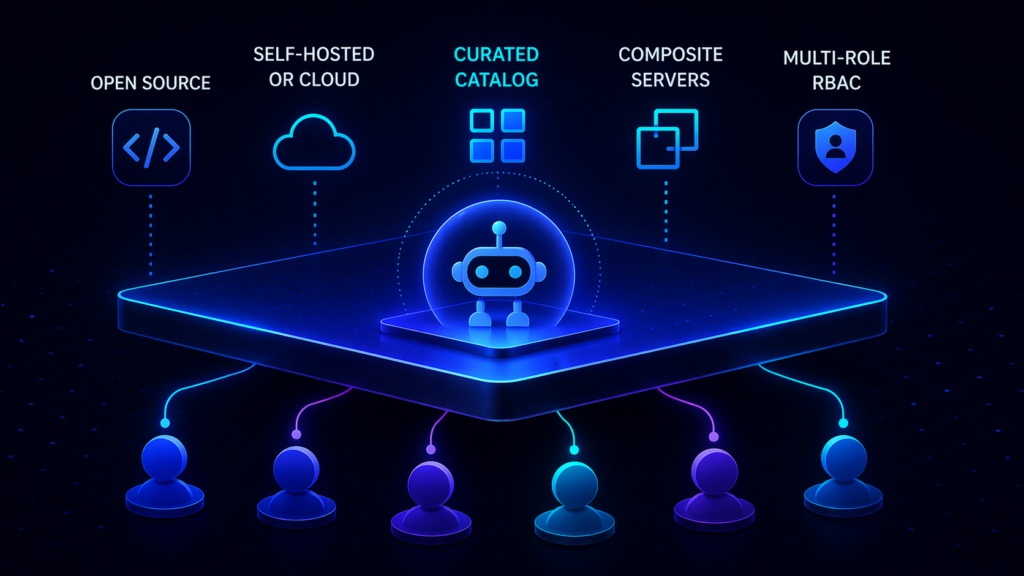
An MCP Gateway provides a centralized layer for managing, securing, and scaling connections between AI applications and Model Context Protocol (MCP) servers. This guide explains how MCP gateways work, their core capabilities, enterprise use cases, and why they’re becoming a foundational part of production AI infrastructure.
What Is an MCP (Model Context Protocol) Gateway?
An MCP (Model Context Protocol) gateway is an intermediary layer that simplifies how AI applications connect to multiple MCP servers. It acts as a single point of entry for AI agents like Claude or ChatGPT to access external tools, resources, and workflows through the MCP protocol.
Instead of requiring direct, individual connections between each MCP client and server, the gateway consolidates these interactions, making system integration easier and more scalable. In the MCP architecture, each MCP client typically connects one-to-one with a specific MCP server. This model can become complex as the number of servers grows. An MCP gateway addresses this by managing all client-server interactions on behalf of the AI application.
It routes requests, negotiates capabilities, and enforces protocol rules while abstracting transport and lifecycle details. The gateway supports both local and remote servers, regardless of whether they use stdio or streamable HTTP transport. It handles connection establishment, message framing, and secure communication across different transport mechanisms.
This allows AI applications to treat all servers uniformly through the gateway, even if the underlying transports differ. MCP gateways are especially valuable in environments where agents must interact with multiple heterogeneous systems, such as databases, file systems, APIs, or design tools.
An MCP gateway acts as a central orchestration point that routes, secures, and manages traffic between clients and multiple MCP servers. Instead of interacting with each tool server individually, clients send requests to the gateway, which then determines where the request should go, applies policy, and handles the response aggregation.
The gateway functions as a reverse proxy that abstracts away the complexity of managing multiple backend servers. It centralizes functions such as authentication, authorization, request routing, and response formatting. This design allows backend MCP servers to remain focused on their primary function without needing to replicate infrastructure responsibilities like OAuth setup, access control, or request logging.
The gateway introduces a unified entry point, meaning all external clients interact with a single, consistent API regardless of how many backend servers are involved. This simplifies integration and configuration for developers and reduces operational sprawl. Security policies, rate limits, and role-based access controls are enforced centrally, which eliminates the risk of inconsistent configurations across different tool servers.
Internally, the gateway applies routing logic to direct requests to the appropriate MCP server. It supports load balancing to distribute traffic and caching to speed up repeated responses. It also aggregates results when multiple backends are involved in fulfilling a request, ensuring the client receives a coherent response in a standard format.
To understand where gateways fit within the broader protocol – including client–server interactions and context flows – see our guide on MCP Architecture.
Key Features and Capabilities of MCP Gateways
Deployment and Lifecycle Management
MCP gateways manage the initialization, configuration, and shutdown of connections between AI applications and MCP servers, based on the MCP data layer’s lifecycle management features. These gateways abstract away the complexity of setting up individual MCP clients for each server, enabling dynamic connection handling as servers are added, removed, or updated.
At deployment, the gateway is responsible for establishing transport-specific communication channels, either through STDIO for local servers or streamable HTTP for remote ones. It manages authentication details required by the transport layer, such as OAuth tokens or API keys, and handles capability negotiation between clients and servers. This ensures that only compatible features are activated during a connection.
The gateway also manages session state, maintaining persistent session contexts for complex workflows as well as persistent or transient connections as needed. It also handles session management through endpoint configuration, along with connection initialization sequences, error recovery, and graceful shutdown procedures. This orchestration allows backend servers to remain focused on serving context, without duplicating logic for session handling or reconnection logic.
Routing and Proxying
The MCP gateway functions as a centralized router that proxies requests between AI applications and multiple MCP servers, acting much like an MCP proxy while simplifying architecture by separating tool management from tool consumption. Instead of connecting directly to each server, clients send JSON-RPC requests to the gateway. The gateway then determines the appropriate destination server based on routing logic, which can be context-aware based on AI agents’ intent, forwards the request, and returns the response to the client.
This routing mechanism supports both static configurations and dynamic service discovery. For example, the gateway may maintain a registry of available tools, resources, and prompts exposed by each server, using */list methods for discovery. When a client invokes a tool or accesses a resource, the gateway matches the request to the correct backend.
The gateway also handles execution routing. When a client sends a tools/call request, the gateway determines which MCP server owns the tool and forwards the request accordingly. This supports multi-server orchestration where a single AI application may access functionality from many backends.
Security and Access Control
Security in MCP gateways is managed at the transport layer, where the gateway handles authentication, authorization, and secure communication between clients and servers. For remote connections over HTTP, the gateway supports standard methods such as bearer tokens, API keys, and custom headers. It can also integrate with enterprise SSO for authentication, including Azure AD. OAuth is recommended for issuing access tokens, and the gateway is responsible for injecting and managing these credentials per server policy.
The gateway acts as a security boundary between the AI application and external systems. It enforces access control policies centrally, deciding which tools, resources, or prompts each client can access. This prevents inconsistent access configurations across individual MCP servers and reduces the risk of unauthorized operations.
Observability and Telemetry
The MCP gateway provides observability across client-server interactions; without one, security and monitoring across systems become harder. Since all traffic passes through the gateway, it can collect telemetry data on request rates, latencies, errors, and server responsiveness, letting teams monitor latency from a central point. This data enables operators to monitor the health and performance of the entire MCP network from a central point.
Gateways can also log protocol-level events such as connection initialization, capability negotiation, tool execution, and lifecycle changes. These logs are useful for debugging, auditing, usage analytics, and audit logging, while also giving visibility into MCP traffic, agent behavior, and MCP server usage across the ecosystem. Since MCP supports logging as a client primitive, gateways can act as receivers of log messages from servers, further consolidating operational insights.
Catalog and Tool Discovery
One of the gateway’s core responsibilities is aggregating and exposing the available tools, resources, and prompts from all connected MCP servers. Using the MCP data layer’s discovery methods (e.g., tools/list, resources/list, prompts/list), the gateway builds a unified catalog for discovery across different MCP servers and what each backend can offer.
This catalog enables AI applications to dynamically explore available functionality without needing to query each server directly. For example, a client can issue a single tools/list request to the gateway and receive a merged response containing tools from multiple MCP servers, giving teams one registry for approved MCP servers. This discovery layer can also act as an MCP registry for server metadata and lookup.
The gateway ensures that catalog entries are up to date by responding to real-time updates sent through the notifications mechanism. When a server adds or removes a tool, the gateway receives a notification and refreshes the catalog accordingly, including existing MCP servers as they are registered and updated.
In AI agent platforms, MCP gateways act as the communication layer between the agent runtime and external tools or models. Agents issue requests using a standardized protocol, and the gateway ensures those requests are routed to the correct tool service regardless of where or how it’s hosted.
This abstraction simplifies tool integration and supports dynamic tool selection at runtime. It also enables security enforcement, logging, and observability across all tool invocations, which is essential for AI systems and helps organizations scale AI usage by managing multiple agents and tools. This becomes especially important for agentic ai systems, where agent usage can spike unpredictably, so the gateway can manage fallback behavior, retries, and tool version selection without changing agent logic while preventing upstream MCP servers from becoming bottlenecks.
Enterprise AI Integration
Enterprises often rely on a mix of internal services, third-party APIs, internal APIs, and cloud-hosted models. An MCP gateway allows these disparate systems to expose model or tool functionality through a unified interface that adheres to enterprise access and compliance requirements.
This simplifies internal consumption by centralizing authentication, enforcing policy, and integrating with enterprise IAM systems. It also enables consistent logging and audit trails for governance. In practice, it acts as a central hub for servers and tools in enterprise environments. When models are spread across departments or cloud providers, the gateway handles routing and access mediation transparently while reducing operational burden as models and tools spread across teams.
Multi-Tenant or Multi-Application Environments
MCP gateways support environments where different tenants or applications need isolated access to shared backend services. Through tenant-aware routing, policy scoping, and identity-based access controls, including approval workflows for tenant or application access where relevant, the gateway ensures that each tenant sees only its own resources.
This isolation helps maintain security and data integrity across teams or customer environments. It also simplifies backend service development, as individual services don’t need to handle tenant-specific logic. Centralized limits and quotas help enforce fair resource usage, and security teams can use them to oversee fair usage across tenants.
Legacy API Adaptation
Legacy systems often expose custom APIs that don’t conform to modern standards. An MCP gateway can act as an adapter, translating standard MCP requests into legacy formats and converting responses back into a consistent structure. Unlike traditional API gateways, which mainly route and secure HTTP services, it also helps adapt older tools for agent-oriented use.
This enables integration without refactoring old codebases. Similar to API gateways, the gateway can map modern authentication flows onto legacy auth mechanisms, apply normalization to inconsistent schemas, and surface legacy capabilities through the catalog interface as a single entry point. This approach allows gradual modernization while maintaining operational continuity.
The Future of MCP Gateway Integration
The MCP gateway ecosystem is entering a new phase, shaped by demands for higher scalability, intelligence, and cross-domain applicability. Future development is focused on expanding the gateway’s role from a simple protocol intermediary to an intelligent orchestration layer capable of adapting to diverse enterprise needs.
Emerging Patterns
Here’s a quick look at emerging development in the MCP gateway:
Domain-specific gateway plugins: These are becoming more common, especially in sectors with strict regulatory constraints such as healthcare, finance, and legal. These plugins provide tailored handling for sensitive data and compliance enforcement, reducing the overhead for teams working in specialized environments.
AI-driven routing: Instead of relying solely on static routing rules, gateways are beginning to incorporate machine learning models to make dynamic decisions. These models evaluate past performance, server load, and context to optimize which backend server handles each request, improving efficiency and responsiveness and supporting multi-tool orchestration across several backends.
Federated gateway architectures: These allow multiple MCP gateways to interoperate across organizational or geographic boundaries. For example, enterprises with separate security domains or legal jurisdictions can maintain independent gateways while still collaborating on shared workflows. This structure supports distributed tool governance and access control at scale, with a centralized control plane coordinating policy and discovery across federated gateways.
Tool orchestration: More advanced tool orchestration features are being developed as well. These enhancements allow gateways to execute multi-step workflows that span several tools, with built-in branching and conditional logic. This enables AI agents across distributed tools and services to carry out complex tasks, such as data analysis followed by report generation, without requiring manual intervention between steps through a unified control plane.
Ecosystem and Community Growth
The surrounding ecosystem is maturing in parallel. A shared plugin marketplace is emerging, offering reusable extensions and adapters that address common integration needs. This helps teams avoid reinventing the wheel, makes it easier to manage MCP servers at scale, and promotes interoperability.
Community contributions are also driving the development of configuration templates and reference implementations. These resources reduce the effort needed to deploy MCP gateways in specific scenarios by providing tested, enterprise-grade blueprints for authentication, routing, and logging.
Monitoring tools are benefiting from standardized dashboard templates, which make it easier to visualize gateway behavior, identify issues on a specific server, better understand the entire MCP ecosystem, and set up alerts for failures or anomalies, with some stacks also using server sent events for real-time streaming updates. Combined with community-authored best practices, these templates help teams operationalize MCP gateways more reliably and consistently.
Together, these trends indicate that MCP gateways are evolving from infrastructure components into intelligent, domain-aware orchestration layers with robust community backing.
Obot: the MCP Gateway Solution
The MCP ecosystem is expanding rapidly, and organizations need a reliable, standards-aligned way to connect internal systems, agents, and automation workflows. Obot provides a production-ready MCP Gateway, serving as an MCP and AI Skills gateway and centralized layer for enterprise MCP operations that unifies policy enforcement, identity, audit, service interoperability, and MCP security without custom glue code, with support for remote MCP servers.
Start Using Obot Today
GitHub: https://github.com/obot-platform/obot Download the Obot open-source Gateway on and begin integrating your systems with a secure, extensible MCP foundation.
Explore the MCP Integration Whitepaper
Learn how a gateway layer accelerates adoption and improves reliability across multi-agent systems, including how to evaluate open-source MCP gateway options for your infrastructure. Download your free copy of the Enterprise MCP Quick Start Guide here.