The window between “we’re experimenting with this” and “we need a security framework for this” is closing faster than most organizations have moved. MCP adoption has reached the director level and above as a strategic priority, budgets are being allocated, and engineering teams are building. The security infrastructure to support what they’re building, in most cases, is still being scoped.
That sequencing problem is where real exposure lives. Half of organizations are actively experimenting with MCP servers. Only 11% have reached production. Pre-production deployments are pre-hardened by definition, and the attack vectors that matter most in this space don’t wait for a production launch to become relevant. They’re available the moment a server initializes a connection.
This piece maps the threat landscape as it stands in early 2026: six concrete attack patterns with documented mechanics, the adoption gap that concentrates your current risk, a layered defense framework that security and engineering teams can actually ship, and the architectural argument for why centralized governance serves velocity rather than slowing it down.
Why MCP Creates a Fundamentally Different Attack Surface
Most security frameworks assume a clean separation between the system and its instructions. MCP collapses that separation by design. In an MCP ecosystem, AI agents interpret natural-language prompts and decide which external tools to use or what commands to execute through it.
As Bright Security observes, through MCP, models can query databases, call APIs, retrieve documents, and trigger predefined actions based on context provided at runtime. That runtime flexibility is the whole point, and it’s also where the security model gets complicated. Bright Security frames this directly: “From a security standpoint, MCP effectively becomes a control plane for model behavior.” You’re not just securing an API endpoint. You’re securing the mechanism that decides what the model does next.
The Broker Problem
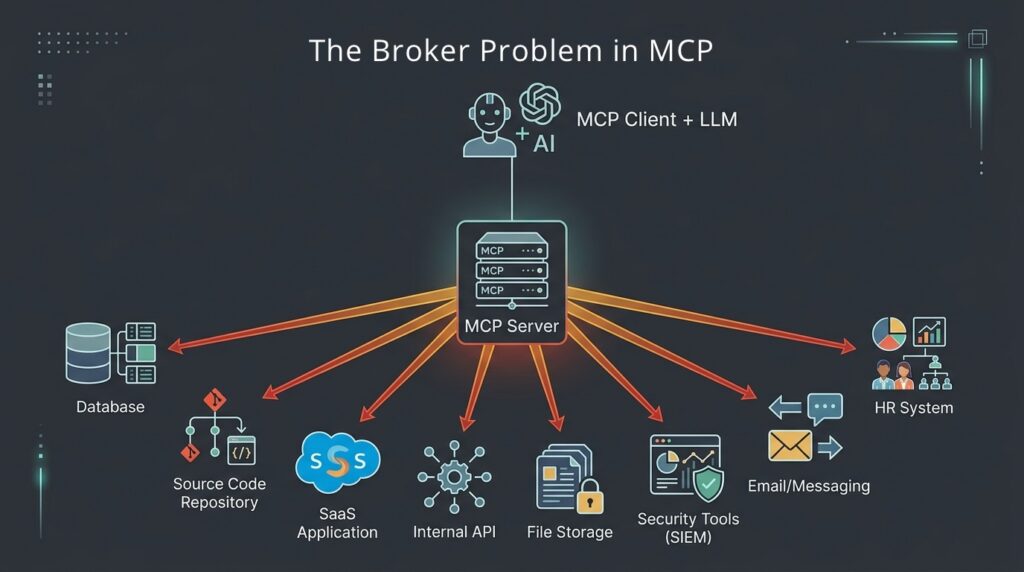
Red Hat’s analysis describes a three-tier structure: the MCP client holds information about what tools each MCP server can access, passes user requests alongside that server context to the LLM, and the LLM responds with the specific tool and parameters to invoke. The MCP server then sits between the model and every downstream system it’s authorized to reach.
SOC Prime notes that MCP servers broker access to downstream systems including SaaS applications, databases, internal services, and security tooling. They can also bridge sensitive systems such as source code managers and databases, so misconfigurations or oversights can lead to unauthorized actions, data leaks, or exposure of sensitive resources. A single compromised or misconfigured server doesn’t create a narrow breach. It creates a lateral path to everything that server is permitted to touch.
Why Conventional Security Testing Misses This
Traditional vulnerability scanning looks for unsafe functions, missing input validation, and unauthorized access paths. MCP vulnerabilities don’t fit that pattern cleanly. According to Bright Security, MCP issues often emerge from “trust assumptions, ambiguous control boundaries, and the way models interpret instructions rather than from obvious coding errors.” The vulnerabilities surface not from a single broken function, but from how multiple context sources are combined, ordered, and interpreted by the model at runtime, especially in systems built around large language models.
A security team running standard API testing against an MCP-enabled system may see nothing alarming in the code itself, while a subtle manipulation of context at runtime produces outcomes no developer explicitly authorized. Effective monitoring also has to review LLM inputs and outputs to catch context injection and attempts to extract sensitive data while the system is running, reinforcing that agents cannot reliably self-defend against prompt injection without infrastructure-level controls. The threat is an AI agent following instructions that appear legitimate but weren’t intended by anyone responsible for the system.
Try Obot today — the open-source MCP gateway. Self-hostable, MIT licensed, full audit trail at every tool call.
The Six Attack Vectors Every Security Leader Must Understand
Six distinct attack patterns have emerged from the MCP threat landscape. Understanding how they work is the prerequisite for defending against them, and organizations should ground their controls in a broader view of top MCP security risks and best practices.
Exposed Servers and the Malicious MCP Server as Open Proxies
The initialization handshake that makes MCP functional also makes exposed servers trivially discoverable. Because the protocol produces a predictable, well-structured response upon connection, automated scanning can confirm a live, unprotected MCP server with a single request, which is exactly the kind of exposure a central MCP proxy focused on security, control, and observability is designed to prevent. As Bitsight’s analysis puts it, a valid initialization response means an attacker “can be 100% sure we’ve found an exposed MCP server that happily initialized a connection from a client without even checking for authorization.” The server then functions as an open proxy to every downstream system its tools are permitted to reach. No credentials required.
Prompt Injection via Tool Metadata and Indirect Injection
Attackers don’t need access to the model itself to influence its behavior. Tool descriptions, parameter names, and metadata fields are all interpreted by the model at runtime, making them viable injection surfaces. Those paths can carry malicious instructions through tool metadata and indirectly retrieved content, signaling malicious intent rather than benign context. Indirect injection is subtler: the model retrieves external content during a task, and that content carries embedded instructions the model treats as legitimate context. The attack payload arrives through a trusted data channel.
Configuration Poisoning
Unlike tool-level manipulation, configuration poisoning targets the MCP server’s operational baseline. Checkmarx identifies this as the introduction of “stealthy permissions, altered defaults, or hidden execution paths” at the server level. To prevent configuration theft, secrets such as API keys, cloud credentials, SSH keys, and values exposed through file systems should be pulled dynamically from enterprise secret managers rather than saved locally in plaintext. Secure token handling should follow OAuth 2.1 guidance for client-to-server communication to reduce configuration theft risk. The result is persistent behavioral modification that survives individual sessions and is difficult to detect through conventional code review because the logic is buried in configuration state rather than application code.
Resource and Data Poisoning
External data fetched by MCP tools is rendered as model input, including content pulled from remote and local data sources. A concrete example from Checkmarx’s research: an MCP tool retrieving CSV data from a remote source encounters a hidden comment embedding a system-level instruction directing the model to exfiltrate variables to an attacker-controlled endpoint, so defenses should scan tool call responses and sanitize returned text before it is fed back into the model. The file might look legitimate. The CSV parser doesn’t flag it. The model executes the instruction.
Supply Chain Compromise
MCP deployments rarely involve a single server. Most production environments chain multiple third-party servers together, which makes this a supply chain security problem because malicious code can enter through any link, underscoring the need for a comprehensive MCP enterprise architecture and reference model that treats the entire chain as a single security surface. One poisoned server in the chain, whether through a compromised dependency, a malicious third-party package, or a tampered configuration, can propagate malicious behavior to every server and downstream system connected to it. Installing an unverified or malicious MCP server can create significant security risks, including data breaches. HackerNoon’s 2026 review of early MCP incidents places supply chain attacks among the most consequential emerging patterns in this space.
Overprivileged Agents and the Confused Deputy Problem
When an agent holds broad permissions but the tool invocation layer applies no authorization checks, an attacker who gains basic execute access can invoke administrative tools the original permission grant was never meant to cover. MCP proxy flows can also trigger the confused deputy problem when attackers abuse static client IDs, dynamic client registration, or authorization-code handling to obtain access without user consent. Network Intelligence’s checklist frames the attack vector precisely: an actor with execute permissions uses the MCP client to invoke database query tools or user management functions without hitting any authorization boundary. That creates room for privilege escalation and unauthorized actions even without breaking the protocol. Servers should verify all inbound requests and avoid using sessions for authentication, which lowers session hijacking risk. Accepting token passthrough without validation is another authorization anti-pattern. The agent becomes a confused deputy, acting on instructions it has the technical capability to fulfill but was never intended to authorize.
Taken together, these six vectors share a common property: none of them require breaking the protocol. They exploit the gap between what MCP permits by design and what organizations actually intend to allow.
The Adoption Gap That Should Keep CISOs Up at Night
The numbers from the Stacklok State of MCP in Software 2026 report tell a specific story. Half of organizations surveyed are actively experimenting with MCP servers. Only 11% have reached production. That 39-point gap is a map of where your exposure currently lives.
Pre-production deployments haven’t been through formal security review. Authorization wrappers, if they exist at all, were added opportunistically rather than by design. The Stacklok data also shows that MCP has already reached director-level and above as a strategic priority, with engineering teams owning it at 41% and architecture teams at 34%. Boards are approving MCP initiatives. Budgets are being allocated. The security posture of those initiatives, in most cases, hasn’t been fully scoped yet.
Strategic commitment has outrun security readiness, which creates pressure on engineering teams to ship without the governance infrastructure to support what they’re building. That pressure is where shadow deployments come from. Developers spin up local MCP servers to move quickly, expose them over HTTP endpoints for testing or demo purposes, and those endpoints persist. No authorization wrapper. No audit trail. No visibility at the organizational level. An HTTP-exposed MCP server without authorization in front of it is functionally an open proxy to every downstream system its tools can reach, and the protocol’s predictable initialization response means automated scanning can confirm a live, unprotected server with a single connection attempt.
The shadow MCP problem is the natural output of a 50%-experimenting, 11%-in-production environment where leadership urgency is high and governance frameworks are still being written.
A Practical Defense-in-Depth Framework for MCP Deployments
As the MCP Security Checklist notes directly, “there is no complete defense against prompt injection.” A layered approach is therefore non-negotiable rather than optional. No single control is sufficient. Effective MCP security relies on external governance and layered security controls such as zero-trust access, transport encryption, and strict runtime guardrails to address core security challenges. The goal is to make exploitation expensive enough that it fails in practice.
Layer 1: Authentication and Transport
Every remote MCP server must follow the MCP specification, and secure remote deployments must depend on strong client server architecture. Security is not just for exposed endpoints. The MCP Security Checklist is explicit: remote servers connecting to remote services requiring authentication must use secure OAuth 2.0, implemented according to step-by-step MCP authentication guidance and best practices. In that flow, the MCP client sends authenticated requests through the standardized protocol before any API call reaches external services. HTTP endpoints without an authorization wrapper in front of them should be treated as open proxies, because functionally that is what they are in the broader MCP architecture.
Audit your current inventory for unauthenticated endpoints. Eliminate them now.
Layer 2: Least Privilege
Scope each agent’s tool access control to the minimum required for its specific task, using least-privilege policies to reduce unauthorized actions, limit data access, and prevent unintended access, and back that design with enterprise-grade access control for MCP servers rather than ad hoc permissions. The confused deputy problem is the predictable outcome of broad permission grants combined with absent authorization checks at the invocation layer. Define tool access by role and task, not by what happens to be available. Permissions and role scopes should be audited regularly to catch privilege creep and stale access.
Layer 3: Input/Output Sanitization
Monitor data flowing through MCP in both directions. This should include MCP messages, not just tool outputs, so hidden directives in transit are caught early. Outbound monitoring catches accidental PII transmission. Inbound monitoring surfaces injection payloads embedded in external data before the model processes them. The MCP Security Checklist recommends implementing content sandboxing for external data and using static analysis to detect hidden instructions in tool descriptions before deployment. Reviewing messages and content at runtime helps detect issues before malicious context reaches the model.
Layer 4: Human-in-the-Loop Controls
Require explicit user approval for sensitive operations. Repeated benign prompts from a malicious MCP server can create consent fatigue, causing users to approve harmful actions without proper review. This is intentional friction. Automating everything feels efficient until an agent executes something nobody meant to authorize. High-stakes commands or custom code execution should stay sandboxed in isolated runtimes and require mandatory human confirmation.
Layer 5: Comprehensive Logging and Monitoring
Capture every MCP request, response, tool invocation, and policy decision. The MCP Security Checklist recommends logging authentication attempts and failures, monitoring token usage patterns, detecting anomalous resource access across mcp components, and routing everything into a SIEM for centralized analysis. Security teams also need runtime monitoring and Runtime Isolation around MCP servers to limit damage if a specific server is compromised, while watching events like tool registration and changes in server behavior for signs of abuse. An audit trail is only useful if it exists before the incident.
Together, these layers close the gap between what MCP permits by design and what your organization intends to allow.
How a Centralized MCP Gateway Turns Governance Into a Velocity Accelerator
The five-layer framework tells you what to build. The harder operational question is where to build it. Centralized MCP security creates a control plane for safely connecting enterprise AI models to sensitive databases and business software.
The default path, the one most engineering teams take under deadline pressure, is to implement controls inside each MCP server. That approach distributes the security burden across every developer building every server, guarantees inconsistency, and creates exactly the kind of fragmented coverage that sophisticated attackers look for.
The more durable answer is to centralize those controls at the MCP client and gateway layer, using an MCP gateway as a unified control plane. As Red Hat’s analysis points out, the MCP client already holds the information about what tools each server implements and passes user requests alongside server context to the LLM. That position in the architecture is the most consequential trust boundary in the entire stack. Real-time policy enforcement should evaluate and authorize every AI request before it reaches downstream codebases or databases. Authentication decisions, tool inventory management, authorization checks, and audit logging all belong there, not scattered across individual servers where they’ll be implemented inconsistently or skipped entirely when a sprint is tight. That is also what lets AI systems interact with external data sources through a consistent and secure exchange layer, the role an MCP gateway proxy plays in routing and securing multi-server traffic.
Obot MCP Gateway is built specifically for this problem. OAuth 2.0 implementation is one of the most reliably underestimated challenges in MCP development. Developers get it wrong, skip it under pressure, or hardcode credentials in ways that persist long after they were meant to be temporary, mirroring the dangerous MCP OAuth shortcuts that are already undermining security across early deployments. Obot handles that complexity at the gateway layer, so individual server developers don’t have to solve it repeatedly and imperfectly. A vetted catalog of approved tools gives developers frictionless access to what they need without requiring them to evaluate every third-party MCP server themselves. Centralized visibility over all MCP activity eliminates the shadow deployment problem without restricting what teams can build.
Approved tools are already available, already authenticated, already logged. The friction of waiting for security review disappears because the review happened once, at the catalog level, not repeatedly at the point of each new deployment. Security leaders get the audit trails they need. Developers get the speed they need. That same visibility also helps satisfy GDPR and HIPAA auditability requirements around data access.
The Window to Get Ahead of This Is Now
Twelve months ago, these vulnerabilities were theoretical. Today, the Stacklok data shows half of organizations already experimenting with MCP servers, Bitsight is documenting exposed instances in the wild, and the six attack vectors covered here are being actively explored. The experimentation gap isn’t closing on its own.
The organizations that come out of this period ahead are the ones that build the governance layer before the sprawl outpaces their ability to see it. Authentication at every remote endpoint, least-privilege tool access, centralized logging, and a vetted catalog of approved servers aren’t restrictions on what teams can build. They’re the foundation that lets teams build faster without accumulating risk they can’t measure. Obot MCP Gateway exists precisely for this moment. The window is still open.